
The case for choosing historical recordings
Posted by: u5227470736789439 on 11 November 2007
Dear Friends,
With so much great historical music making emerging from Radio archives and also issues of out of copyright material from expert independent labels, it seems to me to be tipping the balance from buying recordings from currently performing artists towards those of acknowledged master musicians of past eras.
The best would be to attend live performances of contemporary artists, and use the reference of older recordings as a yardstick to see if modern performance practise represents a musical and spiritual advance. At last the gramophone is doing what Elgar predicted in 1926, and becoming a reference point historically in music. That must have taken vision as few would have seen this point at the time as recordings [such as they had been up till 1925, using the acoustic method of capturing sounds] were hardly a record of anything except the horrible compromises in performance styles [and the actual instruments used] necessary to be captured at all. Only great singing tended to be well captured in the acoustic system. The violin family of instruments suffered very badly with the acoustic method.
The electric microphone and cutting head changed all that in the last months of 1925, and by April 1926 Elgar embarked on a remarkable series of recordings of his major works, almost unconstrained by technical limitations - four minute sides apart. Even so HMV were recording large sections of live performances by 1927, though the technical results were rather variable at concerts. The best still have a phenomenal immediacy and visceral quality all too absent from either modern recordings or even all too many modern concert performances. Other great musicians like Rachmaninov soon followed ...
I was forced to consider this when reading what the late Philip Hope-Wallace said of old gramophone recordings in 1989:
"In the olden days, the performers attempted to capture the feeling of a live event in the studio, whereas now performers attempt to capture the [edited] perfection of the modern studio recording in the concert hall." No wonder all too many modern concert performances tend to be safe and consequently dull!
ATB from George
PS: Obviously this has no significance where the recording of a modern work is the first the public gets to hear of it, whether in the classical domain or the more popular genres, or when the performance comes from the composer or song writer.
With so much great historical music making emerging from Radio archives and also issues of out of copyright material from expert independent labels, it seems to me to be tipping the balance from buying recordings from currently performing artists towards those of acknowledged master musicians of past eras.
The best would be to attend live performances of contemporary artists, and use the reference of older recordings as a yardstick to see if modern performance practise represents a musical and spiritual advance. At last the gramophone is doing what Elgar predicted in 1926, and becoming a reference point historically in music. That must have taken vision as few would have seen this point at the time as recordings [such as they had been up till 1925, using the acoustic method of capturing sounds] were hardly a record of anything except the horrible compromises in performance styles [and the actual instruments used] necessary to be captured at all. Only great singing tended to be well captured in the acoustic system. The violin family of instruments suffered very badly with the acoustic method.
The electric microphone and cutting head changed all that in the last months of 1925, and by April 1926 Elgar embarked on a remarkable series of recordings of his major works, almost unconstrained by technical limitations - four minute sides apart. Even so HMV were recording large sections of live performances by 1927, though the technical results were rather variable at concerts. The best still have a phenomenal immediacy and visceral quality all too absent from either modern recordings or even all too many modern concert performances. Other great musicians like Rachmaninov soon followed ...
I was forced to consider this when reading what the late Philip Hope-Wallace said of old gramophone recordings in 1989:
"In the olden days, the performers attempted to capture the feeling of a live event in the studio, whereas now performers attempt to capture the [edited] perfection of the modern studio recording in the concert hall." No wonder all too many modern concert performances tend to be safe and consequently dull!
ATB from George
PS: Obviously this has no significance where the recording of a modern work is the first the public gets to hear of it, whether in the classical domain or the more popular genres, or when the performance comes from the composer or song writer.
Posted on: 11 November 2007 by joesilva
Dear George,
I could not agree with you more. Recently, I have noticed that about 80% of the recordings that I buy (either cd or lp) tend to be reissues of great recordings from the early fifties to the mid sixties, particularly classical and jazz recordings. I've found some even earlier recordings to be of very high musical quality. A lot of what you get today, particularly with modern classical musicians, is pure technique with very little musical expressiveness. Luckily, many of the great recordings have survived, and many sound even better than when they were originally released since we are dealing here with the original master tapes rather than a copy of a copy of a copy of a copy of a copy ......
regards,
Joe
I could not agree with you more. Recently, I have noticed that about 80% of the recordings that I buy (either cd or lp) tend to be reissues of great recordings from the early fifties to the mid sixties, particularly classical and jazz recordings. I've found some even earlier recordings to be of very high musical quality. A lot of what you get today, particularly with modern classical musicians, is pure technique with very little musical expressiveness. Luckily, many of the great recordings have survived, and many sound even better than when they were originally released since we are dealing here with the original master tapes rather than a copy of a copy of a copy of a copy of a copy ......
regards,
Joe
Posted on: 12 November 2007 by u5227470736789439
Joe,
Thanks for your view!
Dear Mr Meredith,
I accidentally put this in the wrong place, so do think that you could put it in the Music Room where it probably belongs! Sorry for the mistrake.
Thanks from George
Thanks for your view!
Dear Mr Meredith,
I accidentally put this in the wrong place, so do think that you could put it in the Music Room where it probably belongs! Sorry for the mistrake.
Thanks from George
Posted on: 12 November 2007 by u5227470736789439
Merci beaucoup, Monsieur! Georges!
Posted on: 12 November 2007 by u5227470736789524
I have always thought this was one of the best essays I ever read on listening to music, some of it may apply to this discussion:
May/June 2002
The Intro
by Art Dudley
copyright - Listener Magazine
"I stand in awe and I rattle my face
You break your promise all over the place
You told me you loved me, but what do I see?
Just you comin’ in here spillin’ juice all over me
Odds and ends, odds and ends:
Lost time is not found again!
—Bob Dylan, “Odds and Ends,” 1967
Volume two of the Monumental five-volume set of Bob Dylan’s The Genuine
Basement Tapes reaches an emotional climax with a plaintive song called “I’m
Not There”—no mean feat after the brilliant “Going to Acapulco” and three
takes of “Tears of Rage,” one in waltz time. “I’m Not There” has appeared
before, on The Great White Wonder and on Volume One of The Newly Discovered
Basement Tapes on Surprise Records (the latter credited to Blind Boy Grunt
and The Hawks), and while the version on The Genuine Basement Tapes is the
best sounding of the bunch, you still wouldn’t mistake it for anything other
than a bootleg. About a third of the words are unintelligible, and as if
that weren’t enough of an obstacle, the recording begins in mid-verse, with
no clue as to how much had been played before the tape started rolling. No
way for technology to fix that, I guess.
I was listening to it this morning, and midway through the song I found
myself standing next to one of the speakers with my head bent toward the
tweeter cone, trying to make out the missing words, and trying even harder
to soak up as much of the feeling and atmosphere as I possibly could. I
didn’t remember getting up out of my seat, but there I was. And I wondered:
Was this how people listened to music on the radio and the phonograph when
those things were new?
That may sound like a drag to some, but not me. I like to imagine how it
might have been to have every listening experience so... charged. Whether it
was The Monroe Brothers’ singing “What Would You Give in Exchange” or Josef
Hofmann playing the Mendelssohn Scherzo in E minor, early reproduced music
was something that people had to go out of their way for, something they
strained their ears and imaginations to absorb. It may have been canned, but
it was never background music: It was foreground music.
This is the mystery at the heart of our hobby. Its not about “inventing a
language” to describe what we hear from our loudspeakers, and it isn’t about
identifying new ways to measure new distortions so we can buy new black
boxes to cure them. It’s about the way the technology of sound reproduction
motivates and impacts our relationship with the art of music.
As recently as the 1930s—a time when, for most Americans, the opportunity to
hear recorded music was rarer than the opportunity to hear the real
thing—listeners acted accordingly. Everything else stopped: work, play, and,
especially, conversation. It was not uncommon to lean forward a little.
That relationship has flip-flopped, and nowadays canned music is not only
not special anymore: It's inescapable. Consciously or not, most modern
humans have developed elaborate strategies for ignoring recorded music.
What can we do to make the experience special again? What strategies have we
as audiophiles developed for re-inventing our relationship with recorded
music, in an effort to keep it fresh? We change. Amid those changes are the
sorts of things that enthusiast magazines are all about. If all of you
stayed the same for the rest of your lives, I’d be out of a job.
The commonest kind of change in this hobby is to buy something new and get
rid of something old. And that can be a perfectly fine thing to do. But I
like to think that what sets Listener apart is that we give equal time to
the notion of buying something old and getting rid of something new. Or, in
a more general sense, buying or even making something simple and getting rid
of something that’s monstrous and overwrought.
Even more to the point: We change by getting something that’s right and
getting rid of something that’s wrong.
A few months ago, when we were getting ready to drop our first “Special Mono
Issue” on an unsuspecting audience, I didn’t know what to expect. I’m beyond
delighted to tell you that the response was better than I ever imagined. We
received a grand total of one letter of complaint from Jeff Puha, which
appears on page ii), and everyone else who wrote to us seemed more or less
tickled. In terms of sheer volume of reader mail, our “Special Mono Issue”
was our most successful by far.
What does that say? Well, for one thing, I know what it doesn’t say. It
doesn’t say that mono is the answer to everyone’s listening conundrum. If I
thought the specifics were that important, I’d he busy right now connecting
a fuzzbox in-line with my preamp so I could get that scratchy, bootleggy,
lean-a-little-closer thing going with all my records. Hell, even I know
that’s stupid.
What it does mean is that we must never take our relationship with recorded
music for granted—even as technology is encouraging us to do just that. Our
relationship with music is probably more like our spousal relationships than
we ever imagined: We have to work at it. Constantly. But said work is best
approached with a sense of wonder and a sense of fun.
I think mono is fun. I think lists are fun. So is old stuff—and a lot of new
stuff, too. And five years from now it might be something else. I wouldn’t
even rule Out surround-sound. Tastes change, too. I have no interest in a
hobby—any hobby—that would consider itself immune to style.
Again, the specifics don’t really matter. For one married couple, reading
poetry out loud to each other is the key to keeping their relationship
fresh, and for another it’s handcuffs and edible panties. Different
strategies, similar outcome.
I wish you a satisfying and endlessly thrilling relationship with music. I
wish you the freedom to accomplish this by whatever means seem reasonable,
and even a few that don’t. I wish you enough money that you can buy what you
want at least a little of the time. I wish you enough flexibility so that
you’ll try something totally out of the ordinary from time to time, but not
so much that you’ll abandon the taste and judgment and sense of style that
drew you to your favorite music in the first place. And I presume you’ll
never look down your nose at the people who do things differently. Because
they are no less likely than you to get the same good results.
May/June 2002
The Intro
by Art Dudley
copyright - Listener Magazine
"I stand in awe and I rattle my face
You break your promise all over the place
You told me you loved me, but what do I see?
Just you comin’ in here spillin’ juice all over me
Odds and ends, odds and ends:
Lost time is not found again!
—Bob Dylan, “Odds and Ends,” 1967
Volume two of the Monumental five-volume set of Bob Dylan’s The Genuine
Basement Tapes reaches an emotional climax with a plaintive song called “I’m
Not There”—no mean feat after the brilliant “Going to Acapulco” and three
takes of “Tears of Rage,” one in waltz time. “I’m Not There” has appeared
before, on The Great White Wonder and on Volume One of The Newly Discovered
Basement Tapes on Surprise Records (the latter credited to Blind Boy Grunt
and The Hawks), and while the version on The Genuine Basement Tapes is the
best sounding of the bunch, you still wouldn’t mistake it for anything other
than a bootleg. About a third of the words are unintelligible, and as if
that weren’t enough of an obstacle, the recording begins in mid-verse, with
no clue as to how much had been played before the tape started rolling. No
way for technology to fix that, I guess.
I was listening to it this morning, and midway through the song I found
myself standing next to one of the speakers with my head bent toward the
tweeter cone, trying to make out the missing words, and trying even harder
to soak up as much of the feeling and atmosphere as I possibly could. I
didn’t remember getting up out of my seat, but there I was. And I wondered:
Was this how people listened to music on the radio and the phonograph when
those things were new?
That may sound like a drag to some, but not me. I like to imagine how it
might have been to have every listening experience so... charged. Whether it
was The Monroe Brothers’ singing “What Would You Give in Exchange” or Josef
Hofmann playing the Mendelssohn Scherzo in E minor, early reproduced music
was something that people had to go out of their way for, something they
strained their ears and imaginations to absorb. It may have been canned, but
it was never background music: It was foreground music.
This is the mystery at the heart of our hobby. Its not about “inventing a
language” to describe what we hear from our loudspeakers, and it isn’t about
identifying new ways to measure new distortions so we can buy new black
boxes to cure them. It’s about the way the technology of sound reproduction
motivates and impacts our relationship with the art of music.
As recently as the 1930s—a time when, for most Americans, the opportunity to
hear recorded music was rarer than the opportunity to hear the real
thing—listeners acted accordingly. Everything else stopped: work, play, and,
especially, conversation. It was not uncommon to lean forward a little.
That relationship has flip-flopped, and nowadays canned music is not only
not special anymore: It's inescapable. Consciously or not, most modern
humans have developed elaborate strategies for ignoring recorded music.
What can we do to make the experience special again? What strategies have we
as audiophiles developed for re-inventing our relationship with recorded
music, in an effort to keep it fresh? We change. Amid those changes are the
sorts of things that enthusiast magazines are all about. If all of you
stayed the same for the rest of your lives, I’d be out of a job.
The commonest kind of change in this hobby is to buy something new and get
rid of something old. And that can be a perfectly fine thing to do. But I
like to think that what sets Listener apart is that we give equal time to
the notion of buying something old and getting rid of something new. Or, in
a more general sense, buying or even making something simple and getting rid
of something that’s monstrous and overwrought.
Even more to the point: We change by getting something that’s right and
getting rid of something that’s wrong.
A few months ago, when we were getting ready to drop our first “Special Mono
Issue” on an unsuspecting audience, I didn’t know what to expect. I’m beyond
delighted to tell you that the response was better than I ever imagined. We
received a grand total of one letter of complaint from Jeff Puha, which
appears on page ii), and everyone else who wrote to us seemed more or less
tickled. In terms of sheer volume of reader mail, our “Special Mono Issue”
was our most successful by far.
What does that say? Well, for one thing, I know what it doesn’t say. It
doesn’t say that mono is the answer to everyone’s listening conundrum. If I
thought the specifics were that important, I’d he busy right now connecting
a fuzzbox in-line with my preamp so I could get that scratchy, bootleggy,
lean-a-little-closer thing going with all my records. Hell, even I know
that’s stupid.
What it does mean is that we must never take our relationship with recorded
music for granted—even as technology is encouraging us to do just that. Our
relationship with music is probably more like our spousal relationships than
we ever imagined: We have to work at it. Constantly. But said work is best
approached with a sense of wonder and a sense of fun.
I think mono is fun. I think lists are fun. So is old stuff—and a lot of new
stuff, too. And five years from now it might be something else. I wouldn’t
even rule Out surround-sound. Tastes change, too. I have no interest in a
hobby—any hobby—that would consider itself immune to style.
Again, the specifics don’t really matter. For one married couple, reading
poetry out loud to each other is the key to keeping their relationship
fresh, and for another it’s handcuffs and edible panties. Different
strategies, similar outcome.
I wish you a satisfying and endlessly thrilling relationship with music. I
wish you the freedom to accomplish this by whatever means seem reasonable,
and even a few that don’t. I wish you enough money that you can buy what you
want at least a little of the time. I wish you enough flexibility so that
you’ll try something totally out of the ordinary from time to time, but not
so much that you’ll abandon the taste and judgment and sense of style that
drew you to your favorite music in the first place. And I presume you’ll
never look down your nose at the people who do things differently. Because
they are no less likely than you to get the same good results.
Posted on: 12 November 2007 by Unstoppable
When you think about it, all recordings are historical. They are a record of something that is past. A record. Whether last month or 100 years ago makes no difference. I wish people would get over their limited notions of 'sound quality' because ultimately, there is no such thing.
There is only stuff that's interesting and stuff that ain't. I don't care fuck all about mono/stereo, shellacs/magnetic tape, analogue/digital, ect...
So yeah, I'm all for the historical stuff. Going to concerts as a reference is a good idea too
There is only stuff that's interesting and stuff that ain't. I don't care fuck all about mono/stereo, shellacs/magnetic tape, analogue/digital, ect...
So yeah, I'm all for the historical stuff. Going to concerts as a reference is a good idea too
Posted on: 12 November 2007 by u5227470736789439
Dear Unstoppable,
Here is something I posted yesterday in the Hifi Room, but seemed not to become a point for discussion:
In fairness the gramophone is a messenger. It is almost irrelevant when the recordings were made in the electrical era in terms of their potential musical significance. I even have some very fine digital recordings!
ATB from George
Here is something I posted yesterday in the Hifi Room, but seemed not to become a point for discussion:
quote:
"I like nothing other than stability of components in replay, though I quite agree that the better the set the less likely to be significant of itself in getting in the way of the music.
"Currently I am having some very naughty thoughts about mono, having implemented a solution to the idiocy of stereo in natural recordings of classical music. Sometimes it has a minor contribution to make on very small chamber groups where the natural setting for them live is a small Hall like the Wigmore Hall, where a certain amount of directionality to the individual instruments may be perceived if you sit near the front, but otherwise marked stereo is completely un-natural and a really big nuisance to appreciating the music lines on an equal footing! Even in such cases the phenomenon of directionality has no musical significance in more than nineteen out of twenty cases!
"Even the producers of new issues of mono material are now recognising the fact the optimal replay method uses only one loudspeaker! ... This is how these issues are being remastered! So much for multi-channel music replay, then! A red herring!!
"We may be witnessing a minor vinyl resurgence, but this will as nothing compared to the actual return to the most musically satisfying sort of musical replay, which is mono, and avoids silly gimmicks!"
In fairness the gramophone is a messenger. It is almost irrelevant when the recordings were made in the electrical era in terms of their potential musical significance. I even have some very fine digital recordings!
ATB from George
Posted on: 12 November 2007 by u5227470736789439
Dear Jeff,
What a wonderful perspective you quote brings to the issue!
ATB from George
What a wonderful perspective you quote brings to the issue!
ATB from George
Posted on: 13 November 2007 by droodzilla
Hello George
I admire your enthusiasm for historical recordings, but doubt that I will ever be able to share it. The reasons for this boil down to personal preferences and temperament, which I do not presume to be universal:
Firstly, I think I attach greater significance to the physical aspect of musical reproduction than most people. Some would say that I listen to hi-fi/sound rather than music, but this always strikes me as a false dichotomy, as the enjoyment of music is, for me, inseparable from its physical reproduction. This means that I like being able to hear extra detail after an upgrade - all the more so if the detail concerned reminds me of the physical effort involved in making music (I'm a sucker for the sound of fingers on acoustic guitar strings). It accounts, in part, for my love of the European jazz label ECM, with its meticulous approach to sound engineering. Sadly, it hinders my appreciation of some of the pioneers of jazz such as Parker, Armstrong and Ellington, as I struggle to get beyond poor sound quality to what I do not doubt is the great spirit of the music. I fear that the same would apply to some of the historical recordings which you night recommend. The problem is hiss/noise rather than mono - I have no problem enjoying Kempff's mono cycle of Beethoven piano sonatas, for instance (quite the opposite).
Secondly I have a fairly optimistic view of human nature and progress (or lack of same). My default position is that there are good and bad aspects to culture, society (or whatever) at any point in human history, but that these will vary. Thus, in the case of classical music, I'm naturally inclined to think that there are plenty of great performers around today, as there were in other eras. So I might as well buy an insightful modern performance, with the added bonus of excellent recorded sound. I confess that this is something of an a priori stance, as I have not heard many historical performances.
Finally I don't accept the privileging of live music over recorded music. I've been to some ropey rock concerts where the quality of the live sound made it all but impossible to enjoy the music - music I knew I love, having heard it on CD. Personally, I rarely achieve the level of absorption in music in a live setting that I regularly get from listening to a recording at home. Also, I like what great engineers and producers can do with recorded sound - even if the end results deviate from what can be achieved live.
As I say, personal preferences all - no reason why anyone should agree with them!
I admire your enthusiasm for historical recordings, but doubt that I will ever be able to share it. The reasons for this boil down to personal preferences and temperament, which I do not presume to be universal:
Firstly, I think I attach greater significance to the physical aspect of musical reproduction than most people. Some would say that I listen to hi-fi/sound rather than music, but this always strikes me as a false dichotomy, as the enjoyment of music is, for me, inseparable from its physical reproduction. This means that I like being able to hear extra detail after an upgrade - all the more so if the detail concerned reminds me of the physical effort involved in making music (I'm a sucker for the sound of fingers on acoustic guitar strings). It accounts, in part, for my love of the European jazz label ECM, with its meticulous approach to sound engineering. Sadly, it hinders my appreciation of some of the pioneers of jazz such as Parker, Armstrong and Ellington, as I struggle to get beyond poor sound quality to what I do not doubt is the great spirit of the music. I fear that the same would apply to some of the historical recordings which you night recommend. The problem is hiss/noise rather than mono - I have no problem enjoying Kempff's mono cycle of Beethoven piano sonatas, for instance (quite the opposite).
Secondly I have a fairly optimistic view of human nature and progress (or lack of same). My default position is that there are good and bad aspects to culture, society (or whatever) at any point in human history, but that these will vary. Thus, in the case of classical music, I'm naturally inclined to think that there are plenty of great performers around today, as there were in other eras. So I might as well buy an insightful modern performance, with the added bonus of excellent recorded sound. I confess that this is something of an a priori stance, as I have not heard many historical performances.
Finally I don't accept the privileging of live music over recorded music. I've been to some ropey rock concerts where the quality of the live sound made it all but impossible to enjoy the music - music I knew I love, having heard it on CD. Personally, I rarely achieve the level of absorption in music in a live setting that I regularly get from listening to a recording at home. Also, I like what great engineers and producers can do with recorded sound - even if the end results deviate from what can be achieved live.
As I say, personal preferences all - no reason why anyone should agree with them!
Posted on: 13 November 2007 by u5227470736789439
Dear Droo,
I really enjoy the Music Room as a place where we can completely disagree [not that I see your taste as being entirely the opposite of mine in this], but we can have a different view without any sense of denigrating the other on any level, let alone a personal one!
There are some dreadful transfers of old recordings and some very good ones. In Bach for example I find it quite hard to find really enjoyable performances from before about 1950, which has as much to do with the style of the performance as the sound of the recording, but there are honourable exceptions.
In the issue of the classical and romantic composers, then I often tend to the view that style has not actually improved in performance over time, though aspects of recordings have in some ways.
For me there is no more satisfying recording of a favourite piece than a modern one that melds great music making with a splendid sounding recording, but given the choice then I would take a great performance in a restricted recording to a dull or unstylish performance in a better recording. I suppose that I am lucky that an awful lot of my significant early musical experiences were at concerts, and also listening to rather old recordings of very fine musical performances, and this has without question formed my tastes, and allowed me to enjoy relatively poor recoordings for their message.
ATB from George
I really enjoy the Music Room as a place where we can completely disagree [not that I see your taste as being entirely the opposite of mine in this], but we can have a different view without any sense of denigrating the other on any level, let alone a personal one!
There are some dreadful transfers of old recordings and some very good ones. In Bach for example I find it quite hard to find really enjoyable performances from before about 1950, which has as much to do with the style of the performance as the sound of the recording, but there are honourable exceptions.
In the issue of the classical and romantic composers, then I often tend to the view that style has not actually improved in performance over time, though aspects of recordings have in some ways.
For me there is no more satisfying recording of a favourite piece than a modern one that melds great music making with a splendid sounding recording, but given the choice then I would take a great performance in a restricted recording to a dull or unstylish performance in a better recording. I suppose that I am lucky that an awful lot of my significant early musical experiences were at concerts, and also listening to rather old recordings of very fine musical performances, and this has without question formed my tastes, and allowed me to enjoy relatively poor recoordings for their message.
ATB from George
Posted on: 13 November 2007 by Unstoppable
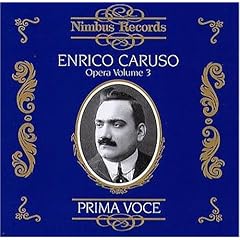
Apparently these were mastered by playing the original shellacs on a wind up style gramophone with horn (specially rigged with a custom electrical motor) the microphone simply recorded the result in an acoustically favorable environment.
It seems like a novel idea to play the records on the equipment it was originally designed for. Something might be lost in the way of fidelity and dynamics but this was a record company taking a chance on a novel approach. The discs were issued in the 80's . A lot of great singers were given volumes and some of them are a real treat. Caruso did more to sell the phonograph from customers buying them simply to hear the great tenors voice. No better recordings exist of 'Celeste Aida' or ' La donna e mobile. Magnifique, sit back and listen to a real treat !
Posted on: 13 November 2007 by u5227470736789439
Dear US,
I was living at Ross-on-Wye only about seven miles from the Nimbus studio near Monmouth when those transfers were made.
With acoustic recordings of singing I think there are strong arguments to be made for the approach Nimbus used! Not the least of which were the resulting transfers themselves!!
ATB from George
I was living at Ross-on-Wye only about seven miles from the Nimbus studio near Monmouth when those transfers were made.
With acoustic recordings of singing I think there are strong arguments to be made for the approach Nimbus used! Not the least of which were the resulting transfers themselves!!
ATB from George
Posted on: 13 November 2007 by JWM
It is hard not to give away my profession sometimes...
An Expert/EMG gramophone is used for this process by Nimbus Prima Voce. This was developed by Michael E Ginn (EMG) who made the original horns out of the London Yellow Pages. He used to produce these in the ground floor rooms of his house in Hampstead and 'society' clients would call in person for demonstrations - these included Delius and Lawrence of Arabia.
I officiated at the funeral of his son (who was himself in branches of engineering all his life) earlier this year.
An Expert/EMG gramophone is used for this process by Nimbus Prima Voce. This was developed by Michael E Ginn (EMG) who made the original horns out of the London Yellow Pages. He used to produce these in the ground floor rooms of his house in Hampstead and 'society' clients would call in person for demonstrations - these included Delius and Lawrence of Arabia.
I officiated at the funeral of his son (who was himself in branches of engineering all his life) earlier this year.