
Statement has landed
Posted by: Graham Clarke on 09 May 2015
So after three long months of waiting, my Statement preamp finally arrived yesterday. I managed to do pretty well in being patient until we got down to around the last ten days… This was the starting point:

Since my Statement home demo via UHES in January I’ve changed my two main interconnects to Super Lumina ones and have swapped out NAC A5 for Super Lumina, at a somewhat excessive cost, but with brilliant results.

To answer a previous question asked on the Forum regarding how these speaker cables are tuned, it is down to the resistor used. The resistor is soldered across the positive and negative cables and then surrounded in the metal box to protect it. This provides the correct inductance that the power amps require. The tuning is the value of the resistor and the type of resistor used (e.g. RS Components, Farnell etc). Required values were determined for specific lengths via listening and then other lengths were calculated via a computer program.
Anyway, onto the day. The plan was to check the torque settings on the S-600 speakers’ drive unit screws, break down, clean, tighten and reconfigure the Fraim racks, install the six Super Lumina DIN-XLR cables and oh, just add the Statement S-1 pre-amp to the mix, replacing the 552…
To complete this task we had four people. Ian and Norman from UHES of course, plus Jason Gould and Mark Raggett directly from Naim. It’s always enjoyable spending time with Ian and Norman but also getting to spend around four hours with Jason and Mark was the icing on the cake.

Ian first checked the speaker torque settings, which turned out to be fine since their last check nearly two years ago. Given I purchased these as ex-demo speakers from UHES it’s probably no surprise that they had already bedded in and didn’t need further adjustment.
I wish I could say the same about the Fraim racks. These were new a year ago and Ian had told me that I should check the tightness of the spikes after a few months because there is a degree of compression and expansion of the wood from new which will loosen them. Having assumed that they would just be slightly loose combined with a degree of laziness and a manic work schedule I’m afraid I hadn’t bothered. Well, when we broke down the power supply Fraim rack and lifted the base off the carpet, one of the spikes remained embedded in the concrete floor, to my embarrassment! So YES, you really DO need to check these with newly built Fraim racks.
During this time break down time, Jason and Mark had man handled the S-1 flight case out of Mark’s car. At least for the UK, these are delivered direct from the factory to the customer. “Man handled” is the correct term given the 102Kg shipping weight but this was slightly easier than in January as the case now has detachable wheels. Direct delivery is done to ensure that the unit turns up in 100% perfect condition both cosmetically and functionally. This was of course not a problem with mine.
While they were busy doing this, I kept myself busy by taking a look at the long awaited DIN-XLR cables.
Anyone familiar with Powerlines or Hi-Lines will recognise the packaging.


As you can see, both ends use the Air-PLUG technology that the other Super Lumina cables use via a set of interconnecting metal rings. The XLR canons are also metal, unlike the original ones.
Jumping forward slightly, the only glitch of the day was that when installing these cables into my Snaxo BMR, the far end of the Air-PLUG connectors on the top cable touch the one beneath. When the system has bedded in I’ll have to see whether this actually makes an audible difference.

There was another box which was unexpected, this turned out to be the Statement accessory kit, the finish of which was beautiful.

There were three layers to this box with the top containing the manual and a spirit level.

The second layer in mine was empty given I had not purchased the Statement power amps. Apparently I am the first person world wide that Naim have supplied with just the pre-amp, all other purchasers have gone for the complete system.
In the bottom layer of the box were a number of tools

Including some Statement Fraim chips (different from standard ones) and the remote control which is in the bag on the right. This is constructed of metal and is similar in weight and feel to the NARCOM remote.
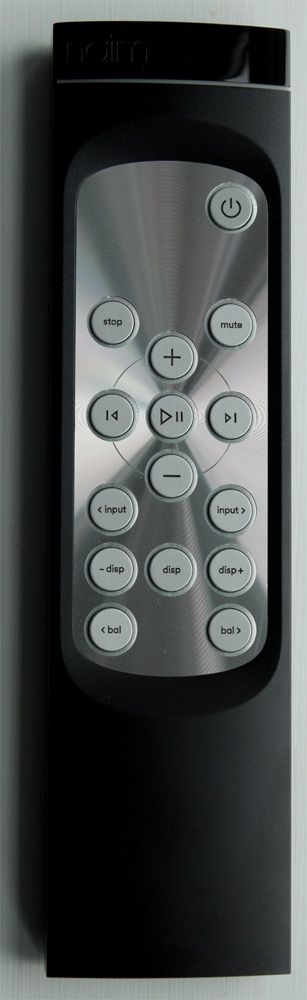
Given the NARCOM remote is £300, I dread to think how much a replacement one of these would be. I better not lose it down the back of the sofa.
After completing the first Fraim rack, Jason and Mark unpacked the pre-amp.

Given the size, weight and space constraints this does need to be planned! With the protective cover removed it finally appeared for the first time.
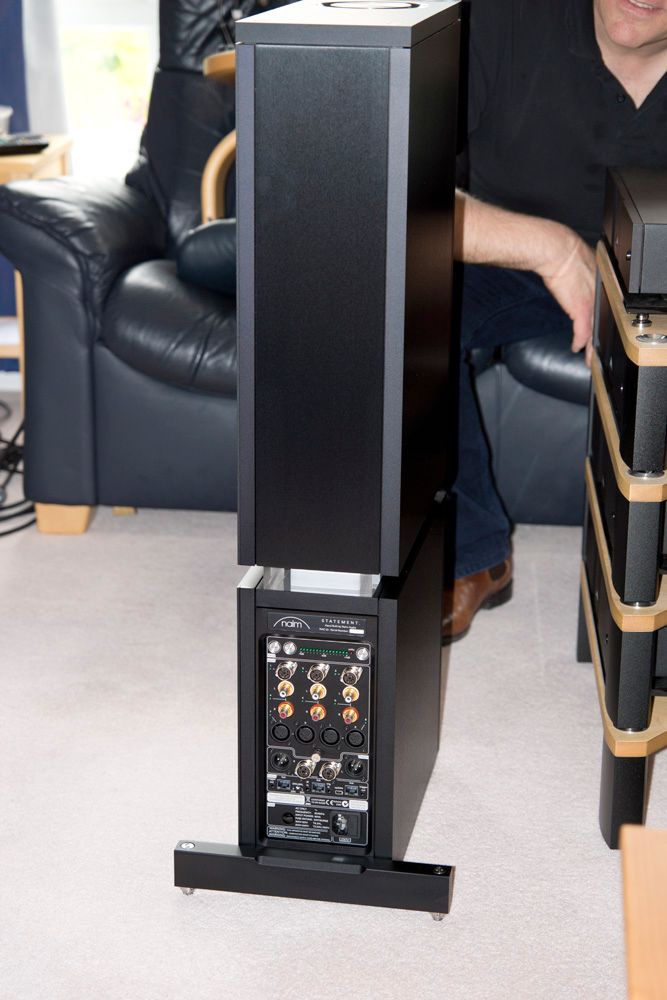
Even unpackaged this weighs 60Kg so moving into position isn’t an easy task. This is what it looks like inside to help explain (no, this isn't mine!)

That's a lot of components!
Happily (for me) I left the task of moving to Mark.

No pressure there Mark, I’m sure you loved me taking pictures of you while you were doing this!

We agree not to put it flush up to the racks so that it could be easily cleaned. Getting the position right, ensuring it was absolutely level and parallel with the left hand rack easily took 30 minutes such was the perfectionist nature of Ian and Mark.
Installing the second Fraim was relatively straightforward after this, poor Ian was left to do this while everyone else chatted and watched on. Jason commented that normally with home installs they get involved directly but knew that they could leave this to Ian given his expertise. High praise indeed for UHES.
One added bonus of moving to two racks and separating them slightly is that cable dressing is now much better, with no Burndys touching the wall and all but a few cables off the floor.

Finally, after over four hours of work, everything was set up and listening was about to begin!

By now it was about 6:30PM and we had a dinner reservation for 7:30 as we were all hungry, so we only had limited listening time. I wasn’t too worried about this because the pre-amp is brand new and stone cold, the DIN-XLRs are also new and the rest of the system would have cooled down, so my expectations weren’t too high.
From the first track there was a slight degree of harshness around the sound. This was consistent with the from cold demo in January. High frequencies were also a little tight and I’d say that the pre-amp and system in generally was probably only at around 50% of its full potential. Despite that, some of the greatness from the January demo was already apparent: the super low noise floor (if it was any lower it would be sucking noise out of the room) along with the incredible detail and separation of every instrument being played.
Unfortunately Saturday obligations mean I won’t get to listen further until later in the afternoon, but both main sources have been left active playing into the system and with further warm up I’m expecting a big jump. So you’ll have to wait a while longer for the clichés and superlatives.
More to follow and thanks for reading if you got this far.


