
Mains upgrade query (yes, another one!)
Posted by: KRM on 11 December 2015
The electrician came round last night and was very patient with my bizarre questions and had a few of his own,
I asked for a hi fi ring (not spur) with minimum 4mm cable on a separate consumer unit. The cable would need to go up the external wall, through the loft, down the external wall and through the wall into the living room.
The cable would be internal grade cable inside trunking to avoid breaks where the cable goes inside, although he initially assumed external cable would be needed.
He wondered if there might be sonic issues with running both cables of the ring (the "out" and the "return") alongside each other in the trunking. Can I ask if others here have done this and whether it's an issue? I know some prefer a spur, but a ring is often recommended.
Also, does it matter if the cables on the external walls get cold? Apparently, the cold increases impedance (or was it resistance?).
I thought it was very nice of him to get in the spirit and I suggested I would ask his questions here so thanks in advance for your thoughts.
By the way, I'm thinking of getting the Russ Andrews consumer unit and using unstitched MK sockets.
Keith
Hi if there are only one set of sockets on the spur .. Then a spur is optimum. If there are multiple groups of sockets then a dedicated ring would be optimal..I can't see why the out and return of a dedicated ring being affected with cables close to each other.
regarding the external wall.. and temperature, it's the resistance that changes with temperature. Impedance is the combination of the complex reactance plus the real resistance, so with mains, change in resistance changes the impedance by the same amount. However this resistance and therefore impedance change will be minimal...and if a possible issue then a wider gauge external mains cable should be used.
Simon
Hi Simon,
A ring doubles the current handling capacity by halving the impedance. Also anecdotal evidence leads some to prefer a ring.
It raises a third question. Have others used external cable for the outside stuff, and accepted the need for breaks, or have thy used internal cable inside trunking?
Keith
Keith indeed that is my understanding about the ring and current capacity... which is why I believe spurs are supposed to be limited to single 13 amp circuit. Hence rings / dedicated rings are preferable.
i would nt say definitely halting the impedance however, although it will halve the resistive element of the impedance.
Simon
Hi Mike,
the "out" and "return was my wording. I know it's incorrect, but I was just trying to make the point that you have two cables instead of one. He was wondering if it would be an issue running them side by side. He wasn't saying he thought it would make a difference - from his point of view the whole thing is pointless because he isn't an audiophile.
You seem to be saying that a single socket ring only needs one cable which implies that the ring and radial are the same?
Russ Andrews recommends rings because they sound better and have lower impedance. I suppose they also require twice as much of his expensive cable. In fact he says (in his booklet) that a spur/radial/whatever can sound worse than the the existing ring. Wouldn't it be great if hi-fi had fewer diametrically opposed solutions 
Yes, I think the electrician was speaking of armoured cable and that internal cable needs trunking if you use it outside. The armoured cable can't be run straight into the back of the internal socket so a break in the cable is then required.
Keith

Keith,
I'm with Simon and Mike on this but I have separate radials coming from a dedicated CSU taken from the tails before the home CSU. Each one goes to a separate MK plug. I wouldn't bother with any fancy CSU, save some money and buy an MK or Wylex box. I would also advise a separate earth as well.
As long as your electrician remains sympathetic to your needs you should have no problems. I was lucky that my electrician had worked at a number of sound studios and understood where I was coming from.
Good luck. Done properly it can make a significant difference to the SQ of your system.
Steve
Keith, to keep things simple and avoid multiple different opinions, bear in mind that 10mm2 cable is really required with the least amount of joints. How you do this, is up to you.
I only have two joints from the meter to the actual individual socket contact area; one inside the consumer unit and the other at the purpose made rail distribution box to 4 sockets. No joint even within the Henley 100a splitter block, before the consumer unit. Very tricky, but can be done.
Hi Keith, according to the NICEIC forum website I found this..
"3.1.2 Spurs and permanently connected equipment
A non-fused spur should feed only one single or one twin BS 1363 13 A socket-outlet and should be connected to the final circuit at the terminals of a socket-outlet, at a junction box* or at the origin of the circuit in the consumer unit.
A fused spur should be connected to the final circuit through a BS 1363 fused connection unit. The rating of the fuse in the unit is not to exceed the effective current-carrying capacity of the cable forming the spur.
The rating of a fuse protecting a fused spur is determined from the total current demand of the spur, up to a maximum of 13 A. Where a fused spur serves one or more socket-outlets, the minimum conductor size for the cable(s) between the fused connection unit and the socket-outlet(s) should be:
. 1.5 mm2 for thermoplastic (pvc) or thermosetting insulated cables with copper conductors
. 1.0 mm2 for mineral insulated cables with copper conductors. "
The advantage of the ring is that you can combine loads more safely under a single MCB and have more than one twin 13 amp socket, with a EIC defined spur (though some use the term radial) the specific load should match its MCB, which is why Spurs are used for connected equipment such as showers and immersion heaters and cookers etc.
I would go for a dedicated ring for reduced noise and improved SQ where you have many 13 amp sockets for your audio. Although you could use a spur/radial for your hifi, but if you do so I would ask your electrician for large gauge wiring to accommodate load regulation issues. I believe with a spur with 13 amp sockets you will be limited to a total combined load of 13 amps... Probably not an issue for audio... but again your electrician should know this well.
Regards
Simon
Mike I am referring to the NICEIC which is the UK regulatory body for electrical contractors where a spur is effectively defined as a single wired connection from a ring or consumer unit. (As per the quote from their tech manual I have referenced). The main consideration is that you are limited to upto two 13 amp sockets on a spur, where as a ring you are not. I believe Keith was considering a dedicated ring or a spur.
in my view a dedicated hifi circuit should be a dedicated ring. There are limitations with old style radial circuits and I have heard such setups failing inspections and ideally should be converted to a ring. I will discuss with my electrical contractor relative for status of old style radial circuits for new deploys.. I am not sure they would be passed by the NICEIC but I am confident he would know.
Simon
Simon, this is not the place for such a discussion, however Keith is considering a dedicated ring or radial. I'm not sure where your information on the use of spur is applied, but its not correct.
BS 7671 clearly differentiates the two domestic power circuit types as ring or radial & only refers to a spur as part of a ring circuit.
Our electrician managed to get the wires from 10mm steel wall armoured cable into the back of a Crabtree unswitched socket without a break. It was trick though. We have a separate consumer unit with 50 amp breakers.
The cable runs round the outside of the house in the flower bed.
Mike-B posted:Simon, this is not the place for such a discussion, however Keith is considering a dedicated ring or radial. I'm not sure where your information on the use of spur is applied, but its not correct.
BS 7671 clearly differentiates the two domestic power circuit types as ring or radial & only refers to a spur as part of a ring circuit.
Mike - I disagree, this subject comes up regularly. As I said I will discuss with my qualified electrician friend and get his views on the applicability and suitability of radial circuits for new deploys in UK domestic setups. If appropriate I will share here. if the NICEIC don't recommend I am not sure it sensible to recommend such setups for UK premises. If they see no issue then great, but otherwise the could be survey observations if someone wants to sell their house in the future. I don't think this is a legal thing, but more a best practice for electrical contractors in the UK as well as safety considerations through radial cable heating = albeit unlikely to be an issue for hifi - but would that radial always be used for hifi with a future owner?
Simon
Hungryhalibut posted:Our electrician managed to get the wires from 10mm steel wall armoured cable into the back of a Crabtree unswitched socket without a break. It was trick though. We have a separate consumer unit with 50 amp breakers.
The cable runs round the outside of the house in the flower bed.
But you would have had a break from the meter via the splitter block, when it goes your hifi cu and home cu.
Keith,
A radial circuit for home audio:
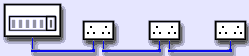
A dedicated radial power supply means using one cable from the consumer unit [aka fuse box] to the appliance in question. For home audio use this would typically go to an unswitched 2-gang MK 12A socket.
More sockets may be added by daisy chaining them together with the same cable, however, it will need a cable core small enough to fit two wires into each 2-gang socket connection, this is generally not doable with a 10mm cable because the copper wire core is too big when paired up, however using 6mm cable it's easy.
Also, ask your professional qualified electrician to upgrade your consumer unit if it's not up to date, and fit the audio dedicated radial power supply fuse to the non RCD side.
Debs
I have discussed the matter of a dedicated supply for my hifi with my electrician (who is a stickler for the NICEIC Regs 17th edition I believe) and having sought advise on the forum (thanks HH & Debs for simple practical advise) he has no problem in installing a new dedicated radial circuit for my audio equipment.
So come Friday next week I'm having a new dedicated consumer unit installed (existing incoming mains will be split before the existing main CU) with a single run of 6mm armoured (he thought 10mm cable would be hard to terminate straight into the back of the socket) run from the new CU round the perimeter wall and terminated right into the back of a face fixed un switched double MK socket.
I seem to recall that other than the cable size (10mm is preferred) this was also the advise offered by Naim via earlier posts on the forum on this topic.
While not being interested in hifi as such my sparky can see the advantage of having a dedicated circuit and it should as a minimum eliminate the annoying pops and clicks heard whenever the fridge freezer kicks.
He is also perfectly happy to certify his work when the installation is complete.
I'll update the forum once the new supply has had chance to burn in on any perceived improvements in overall sound quality.
Yes I now understand on radial circuits it's the radial length and the total current and the specification MCB current trip with respect to cable size where there are considerations/ limitations . But on a dedicated radial specifically for low current audio equipment this should not be an issue.
I maintain however a dedicated ring is best for load regulation for a given conductor size. and therefore noise, as well as safety earth resilience, and in a typical house the incremental cost for a dedicated ring over a radial or attached equipment MCB spur is minimal. It's a dedicated hifi ring that I will be having installed with my electrician hopefully next year to replace my current dedicated RFI impeding braided spur off a shared ring.
Simon
Hanumike,
I ran a 10mm armoured cable from the consumer unit direct to a fixed plate socket and it definitely sounded different.
After a while I plugged my rig back into a regular socket on the downstairs ring and much preferred it. I wondered if it was the construction of the armoured cable which degraded the sound.
ATB Ray
Make sure that the electrician takes the earth from the new consumer unit straight to the meter. That will ensure it is as clean as possible. As I said above, I use SWA and only found positive impacts on the sound. I use 10mm and installation was fine, but it's massive and hard to handle - the NACA5 of mains cable.
Mike, ok just had a conversation with my electrician friend. So it appears the times are a changing.. and the main driver historically for ring mains was the multiple bonding points, which in the UK has been removed, so the boding is done once for water, gas and oil on the metal pipe entering the house...
now my set up of having multiple rings is unusual, many uk houses now have single rings which are not ideal.. so a preference is coming, and he feels the regs will be changing to further support, for multiple protected radial legs... which is the norm he tells me for much of Europe.
now a radial is limited to 20 amps max, and a ring 32 amps, but other than possibly kitchens there is not much demand for a protected leg above 20 amps.
i got confirmed the difference between a radial and a spur.. Other than a spur is limited to 13 amps, it all about protection. A radial is specifically protected at the consumer unit, a spur is not seperately protected and can be off a ring, radial or junction box..
so, food for thought on the ring or radial next year...
oh yes, one thing he did say is PF consideration, and with the large Naim transformers you may need to consider the power factor to avoid une pecked voltage drop or to use larger cable to compensate.
Simon
A competent electrician can convert a ring to two radials very easily, by splitting the ring and then fusing each branch separately and correctly.
Edit: BTW if you want to do it properly like me, it's 25mm2 uncut from the meter to the cu, there on it's 10mm2 all the way to the sockets. Check the regs, it's all there. Oh, and wire fuse cu is still allowed and better.
Thanks everyone for your replies. I've not been around so I'm trying to catch up with the advice.
I will try to sumarise.
As I suspected, the radial verses ring debate continues to rage. It sounds like the radial might be the way forward if I can persuade the electrician to wire armoured 10mm cable straight into the wall socket.
If I go for a ring I can probably get away with two lengths of 6mm. Mike seems to think there is no issue with running the two cables side by side and higher resistance from cold external wire isn't a problem.
HH has suggested an interesting (and cheaper) alternative to the Russ Andrews consumer unit.
I'm still confused about fuses and someone seemed to be suggesting 25mm cable from the meter to the the new consumer unit.
Keith
Hi Keith,
I too have a dedicated radial with 10mm2 cable to the wall socket - an unswitched MK one. The MK ones can take 10mm2 cable, though it is very tough to daisy chain several with this gauge of cable. 6mm2 is far more practical for daisy chaining several sockets.
Hope this helps, FT