
The Well Tempered Klavier
Posted by: Geoff P on 09 August 2009
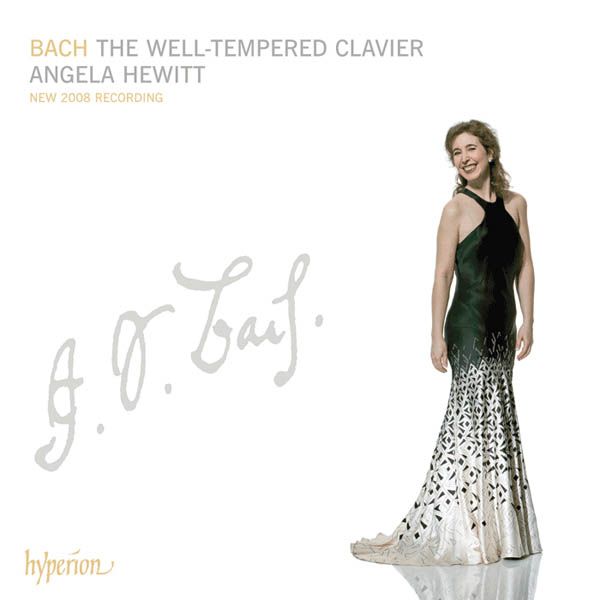
As I mentioned elsewhere I ordered this since it was rumored to be good.
quote:Earwicker commented: Yes, I want Angela Hewitt's remake of the 48 too. I liked her first recordings but I've got to say I found them just a bit disappointing after having heard her play live. In fairness it had something to do with Hyperion's engineering which conspired to lend the proceedings a certain dullness. I'd love the new set, but like Mike, I need to keep my spending under control!!
Well have started listening. I am most of the way thru' disk 1 and bearing in mind what EW said above I am a little concerned that the recording tonal balance seems variable fromm fugue to fugue. A couple are a still a little dull sounding however the majority have quite good ambience although the tonal nature seems to tend toward being a bit 'plinky' in the upper register on a couple, whereas others ( most of them) are just right.
Hewitts' playing technique seems excellent and quite forcefull at times though she does manage 'going quiet' quite well where it is required.On balance I like it so far.
watch this space
Geoff
Posted on: 16 August 2009 by graham55
I am so embarrassed at having introduced the reference to the appalling Queen in a thread about the sublime WTK. I blame the demon drink, but that's no excuse or defence.
Sorry, sorry, sorry...
G
Sorry, sorry, sorry...
G
Posted on: 16 August 2009 by Earwicker
All is forgive, that you have repented of your sins! 
Posted on: 16 August 2009 by Geoff P
That's better...drunken loutsquote:Originally posted by graham55:
I am so embarrassed at having introduced the reference to the appalling Queen in a thread about the sublime WTK. I blame the demon drink, but that's no excuse or defence.
Sorry, sorry, sorry...
G

But as Fredie sings....'Who wants to live forever', which I quite like ( ducks behind stack of Walcha LP's).
Now back to the WTC and my Sunday morning listening which I somehow appreciate the most.
Geoff
Posted on: 16 August 2009 by graham55
Geoff, do you really keep ducks behind your stack of Walcha LPs? Don't they make a bit of a mess?
Graham
Graham
Posted on: 16 August 2009 by Geoff P
Fresh eggs for breakfast???
Posted on: 16 August 2009 by mikeeschman
quote:Originally posted by soundsreal:
Oh come on, I love to give Mike the biz, but please, bagging on Queen?
So does this mean you want to be friends again?
Posted on: 16 August 2009 by graham55
My last word on the DGG Richter 9CD set recently released, and that only because a correction of my earlier post is required. It comprises his complete recordings for the label - that is, concerto as well as solo works.
Apologies for the misinformation above.
G
Apologies for the misinformation above.
G
Posted on: 16 August 2009 by soundsreal
One thing else about Richter, since he recorded quite a bit there are many used lps out there on the cheap to try, although I agree with an earlier post about recording issues with some.
Hi Mike
Hi Mike
Posted on: 16 August 2009 by mikeeschman
Good to have you back, Soundsreal :-)
Posted on: 16 August 2009 by soundsreal
you, too.
Okay, back to Bach for a sec...
I was going through my Bach lps and found a Reference Recordings lp I haven't played in years, Albert Fuller playing Bach on harpsichord, various pieces. Anyone heard it?
I saw a scathing review by Leslie Gerber, so wondering if anyone else has encountered it.
Okay, back to Bach for a sec...
I was going through my Bach lps and found a Reference Recordings lp I haven't played in years, Albert Fuller playing Bach on harpsichord, various pieces. Anyone heard it?
I saw a scathing review by Leslie Gerber, so wondering if anyone else has encountered it.
Posted on: 21 August 2009 by mikeeschman
Last night, the Well Tempered Clavier by Kenneth Gilbert on Harpsichord arrived.
I listened to the first disc.
The sound of the recording is ultra-clear and noise free. Gilbert's playing is exceptional, and his mastery is complete. Every tempo makes sense so far, and every voice is clear as a bell.
But the lack of an audible touch (harpsichord is not touch sensitive) as on a piano seems to suck the life right out of the listening experience. It is a real chore to listen to these. Frankly, I don't know if I'm up to enduring this entire set, and it is the dry, brittle sound of the harpsichord that is to blame.
At this point, I much prefer the warm living presence of a piano to the arid presentation of a harpsichord.
I listened to the first disc.
The sound of the recording is ultra-clear and noise free. Gilbert's playing is exceptional, and his mastery is complete. Every tempo makes sense so far, and every voice is clear as a bell.
But the lack of an audible touch (harpsichord is not touch sensitive) as on a piano seems to suck the life right out of the listening experience. It is a real chore to listen to these. Frankly, I don't know if I'm up to enduring this entire set, and it is the dry, brittle sound of the harpsichord that is to blame.
At this point, I much prefer the warm living presence of a piano to the arid presentation of a harpsichord.
Posted on: 21 August 2009 by u5227470736789439
If you don't like them, ...
I will send you an email later.
ARB from george
I will send you an email later.
ARB from george
Posted on: 21 August 2009 by Geoff P
I have been comparing a selection of preludes and fugues as played by Hewitt and Walcha.
The harpsichord is very crystalline and almost piercing at times. It passes all the detail and musical construction across in a way that is so intense that it is physically challenging ( at least for me) to listen for more than say 30 minutes at a time.
I have a long standing love of piano music so find Hewitt very accessible in a much more relaxed way. Her playing has a great sense of confidence to it and is respectfull to what I feel Bach should sound like without being so intense as Walcha. I feel I could listen to her 48 pairs in one session ( though I am unlikely to ever do it).
Both Walcha and Hewitt to me are very arresting in their playing though they are an entirely different aural and mental expertince.
regards
Geoff
The harpsichord is very crystalline and almost piercing at times. It passes all the detail and musical construction across in a way that is so intense that it is physically challenging ( at least for me) to listen for more than say 30 minutes at a time.
I have a long standing love of piano music so find Hewitt very accessible in a much more relaxed way. Her playing has a great sense of confidence to it and is respectfull to what I feel Bach should sound like without being so intense as Walcha. I feel I could listen to her 48 pairs in one session ( though I am unlikely to ever do it).
Both Walcha and Hewitt to me are very arresting in their playing though they are an entirely different aural and mental expertince.
regards
Geoff
Posted on: 21 August 2009 by mikeeschman
This week I completed listening to Hewitt play the WTC. The recording is exceptionally clear and the sound of the Fazioli Grand is so faithfully rendered it is startling. Hewitt's touch and voicing are always unique and exceptional, but her meter is distracting at times.
This is my introduction to the WTC. I have found that my limit is about 12 tracks. After that, it becomes hypnotic, and when you snap out of that, it degenerates slowly to a drone.
I found Book 1 to be joyous. Though most are in four voices, some are in two voices and at least one is in five voices. That creates a richer spectrum of colors, mixing up the voices like that.
Book 2 is more austere, and is cast entirely in four voices. There are beautiful arias in Book 2, and she usually makes them sing.
I was interested to find that there are contemporary works that traverse the keys and predate the WTC, but none of them are complete.
Hewitt only broke my concentration four times :
1 - On disk 1 in a fugue, she let the tempo slacken when introducing new fugue voices.
2 - Three fugues on Disk 3 are too slow to "light up".
On Disc 4 Track 15, she exhibits an unrelenting sense of forward momentum few could aspire to.
I'm going to listen again, and pull the music out when I am distracted by what I hear.
I am excited about Hewitt. If she put out another set in five years, I would eagerly snap it up :-)
This is my introduction to the WTC. I have found that my limit is about 12 tracks. After that, it becomes hypnotic, and when you snap out of that, it degenerates slowly to a drone.
I found Book 1 to be joyous. Though most are in four voices, some are in two voices and at least one is in five voices. That creates a richer spectrum of colors, mixing up the voices like that.
Book 2 is more austere, and is cast entirely in four voices. There are beautiful arias in Book 2, and she usually makes them sing.
I was interested to find that there are contemporary works that traverse the keys and predate the WTC, but none of them are complete.
Hewitt only broke my concentration four times :
1 - On disk 1 in a fugue, she let the tempo slacken when introducing new fugue voices.
2 - Three fugues on Disk 3 are too slow to "light up".
On Disc 4 Track 15, she exhibits an unrelenting sense of forward momentum few could aspire to.
I'm going to listen again, and pull the music out when I am distracted by what I hear.
I am excited about Hewitt. If she put out another set in five years, I would eagerly snap it up :-)
Posted on: 23 August 2009 by mikeeschman
In Book 1, Fugue 2, the one in C minor, I incorrectly heard a rest in all four voices as a slackening of tempo, probably because she is bending the beat a bit at this point.
So that explains Book 1 discrepancies :-)
So that explains Book 1 discrepancies :-)
Posted on: 23 August 2009 by Earwicker
I'm just waiting for a couple of invoices to (hopefully!) get paid then I'm going to order me a copy of Hewitt's new WTC.
She's a very fine pianist and if ever you get to see her live, she's got a really nice bum too!
EW
She's a very fine pianist and if ever you get to see her live, she's got a really nice bum too!
EW
Posted on: 23 August 2009 by mikeeschman
quote:Originally posted by mikeeschman:
In Book 1, Fugue 2, the one in C minor, I incorrectly heard a rest in all four voices as a slackening of tempo, probably because she is bending the beat a bit at this point.
So that explains Book 1 discrepancies :-)
Kept listening and the D Minor in Book 1 is a problem. It is track 11 and 12 on Disk 1.
In the prelude everything is glorious and happy. This prelude is one of the highlights of the disk. But the matching fugue sounds somber from the get go, and sometimes the rhythm sounds "halting". It turns out the "halting" quality comes from a rubato where a flat 7th is being used to modulate from the major to the minor. Or at least that's what my wife found in the music.
Now I'm going to try and hear that ...
OK, that works for me. So I'm going to accept her at her word from here on out.
Posted on: 26 August 2009 by mikeeschman
On second listening, I am coming to accept Hewitt's use of a flexible meter, and am beginning to hear it the way I think she intended it.
I can see the beauty it brings to the music.
I can see the beauty it brings to the music.
Posted on: 26 August 2009 by Geoff P
I have had a listen to Walcha and then Hewiit playing this pair.quote:Kept listening and the D Minor in Book 1 is a problem. It is track 11 and 12 on Disk 1.
In the prelude everything is glorious and happy. This prelude is one of the highlights of the disk. But the matching fugue sounds somber from the get go, and sometimes the rhythm sounds "halting". It turns out the "halting" quality comes from a rubato where a flat 7th is being used to modulate from the major to the minor. Or at least that's what my wife found in the music.
In particular Walcha plays the Fugue without any really noticeable pauses apart from a very slight hint once or twice. Also his tempi, in both the Prelude and Fugue are different from Hewitt by quite a bit.
That is not to say I dislike Hewitt because in fact like you I find her very captivating and enjoyable to listen to.
I have no desire to question either interpretation because I enjoy them both, though I have to say I prefer Heweitt just a little.
rgds
geoff
Posted on: 27 August 2009 by mikeeschman
A friend e-mailed me the D Minor Prelude and Fugue from Book 1 by Walcha for a listen.
The tempos Walcha takes immediately sound fundamentally right. You feel as if Bach is speaking directly to you. And Walcha's playing is faultless.
I have to hear more of these.
But there are problems with harpsichord. The Fugue in D Minor is in three voices which is quite apparent on Hewitt's piano, but you have to focus to pick up the middle voice on Walcha's harpsichord. Of course, this could be because I listened to it as an mp3 on my computer - not the best playback solution.
The tempos Walcha takes immediately sound fundamentally right. You feel as if Bach is speaking directly to you. And Walcha's playing is faultless.
I have to hear more of these.
But there are problems with harpsichord. The Fugue in D Minor is in three voices which is quite apparent on Hewitt's piano, but you have to focus to pick up the middle voice on Walcha's harpsichord. Of course, this could be because I listened to it as an mp3 on my computer - not the best playback solution.
Posted on: 27 August 2009 by mikeeschman
Tonight, we listened to Gilbert (harpsichord), Walcha (harpsichord) and Hewitt (piano) do the Book 1 D Minor Prelude and Fugue with our full attention.
First off, no clearer demonstration of the superiority of the piano is possible.
Hewitt takes the music places you can't go unless you have a piano, and reveals voicing of incredible beauty, especially in the fugue, not apparent in the other recordings.
First off, no clearer demonstration of the superiority of the piano is possible.
Hewitt takes the music places you can't go unless you have a piano, and reveals voicing of incredible beauty, especially in the fugue, not apparent in the other recordings.
Posted on: 28 August 2009 by u5227470736789439
Dear Mike,
The issue of listening to the various voices on a harpsichord is actually very simple.
To start with it may be valuable to have a score to follow what is going on, but the musical ear will very soon pick up a way of keeping the voices both bound together and also entirely discrete in the way that once you know the music you can easily choose one voice and hum it along with the music, as a way of further refining your learning of it.
The piano then does seem to be an over-egging of the cake.
I am gradually concluding that the piano may very well be a good introductory instrument for Bach's fuges, but I suspect that eventually the Bach music lover will almost always gravitite to the harpsichord, which does almost everything else [apart from heavily underlining voice leading] much better.
It is all opinion, and it is my delight to see a thread on this going on!
So I will try to disagree as gently as possible!
ATB from George
The issue of listening to the various voices on a harpsichord is actually very simple.
To start with it may be valuable to have a score to follow what is going on, but the musical ear will very soon pick up a way of keeping the voices both bound together and also entirely discrete in the way that once you know the music you can easily choose one voice and hum it along with the music, as a way of further refining your learning of it.
The piano then does seem to be an over-egging of the cake.
I am gradually concluding that the piano may very well be a good introductory instrument for Bach's fuges, but I suspect that eventually the Bach music lover will almost always gravitite to the harpsichord, which does almost everything else [apart from heavily underlining voice leading] much better.
It is all opinion, and it is my delight to see a thread on this going on!
So I will try to disagree as gently as possible!
ATB from George
Posted on: 28 August 2009 by mikeeschman
We are following along with the score, and have even tried humming, but the inner voices played on harpsichord do not sound clear of the cloud of somewhat nasty overtones the instrument produces.
On piano, all the voicing stands proud without the application of imagination.
Additionally, the inflection of touch natural to the piano opens the music in unexpected ways.
Not to speak too bluntly, there is another consideration. An instrument that goes twang when you press a key is fundamentally flawed :-)
On piano, all the voicing stands proud without the application of imagination.
Additionally, the inflection of touch natural to the piano opens the music in unexpected ways.
Not to speak too bluntly, there is another consideration. An instrument that goes twang when you press a key is fundamentally flawed :-)
Posted on: 28 August 2009 by Geoff P
Not trying to put you under pressure here Mike...but I can hear the 'voices'.... no I am not mad. 
You do have to listen deep for them all at first but then they do show on the harpsichord.

...BTW if there had never been the harpsichord we may never have had the piano
rgds
Geoff
You do have to listen deep for them all at first but then they do show on the harpsichord.
....so, direct twanging of strings is OK but not remote twangingquote:An instrument that goes twang when you press a key is fundamentally flawed :-)
...BTW if there had never been the harpsichord we may never have had the piano
rgds
Geoff
Posted on: 28 August 2009 by mikeeschman
quote:Originally posted by Geoff P:
Not trying to put you under pressure here Mike...but I can hear the 'voices'.... no I am not mad.
You do have to listen deep for them all at first but then they do show on the harpsichord.....so, direct twanging of strings is OK but not remote twangingquote:An instrument that goes twang when you press a key is fundamentally flawed :-)
...BTW if there had never been the harpsichord we may never have had the piano
rgds
Geoff
I can hear the inner voices on harpsichord if I pay close attention, but I hear them regardless on piano. The haze of overtones that hangs in the air around the harpsichord does obscure the inner voices.
You are correct,
I am against remote twanging :-)
The harpsichord may have been a necessary precursor to the piano (actually I think the clavichord holds that distinction) but I don't see a groundswell of musicians yearning to go back.
I haven't forgotten that Bach's favorite keyboard was the clavichord, and that he was an avid proponent of the piano, and played a big role in it's perfection.
When my brain becomes clogged with music, I like to rinse it out with "Instruments of the Middle Ages and Renissance" by David Munrow, specifically so I can hear really old bar room music on instruments that grunt, squeek, weeze, rasp or otherwise assualt your sensibilities. But I prefer a more refined articulation for music of substance.