
Exploring Mahler
Posted by: mikeeschman on 22 February 2009
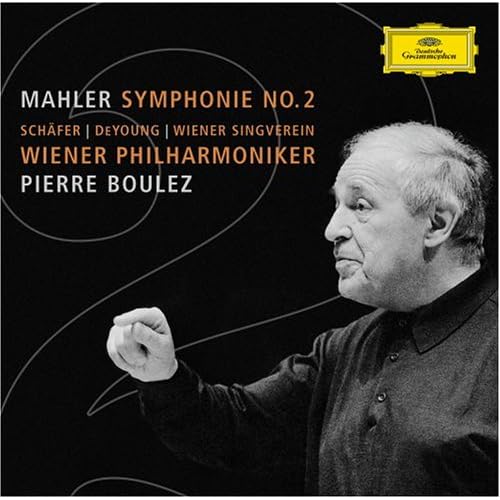
i've spent the weekend listening to mahler's second, both the boulez above, an a stokowski/london on rca (an lp), that is no longer available. the stokowski is a super-romantic barn burner that probably does better service to the period, but the boulez is compelling because it brings much needed order and clarity to the piece, and the playing of vienna is stunning.
the second symphony is five movements, the fourth and fifth employing lyrics. the piece doesn't have the organic unity you find in a beethoven symphony, it is more operatic. themes come and go, punctuated by dramatic climaxes, and finally breaking into song.
a little sloppy and gushing, but i haven't been able to stay away all weekend. as you meander and lurch towards a conclusion, you pass through sequences of such stunning beauty that the piece is ultimately a worthwhile listen, and vienna is awesome in their perfection.
of all composers, mahler may be the greatest orchestrator.
The lyrics are from german folk poetry, and the structure of the symphony is highly programmatic.
"The long first movement began as a standalone symphonic poem based on a novel sonata-form structure with, to put it simply, two development sections." or, as it sounds to me, the movement isn't in sonata form, because it has two development sections. the symphony sounds like it would be better divided into acts and scenes, than into exposition, development and recapitulation.
The second movement should contrast with the first. In fact, Mahler was so concerned about this that he asks for a five minute pause. "Here Mahler is trying to show an interlude in the life of the person deceased in the first movement."
for more details on the structure and history of this symphony, you can look here :
http://www.musicweb-international.com/Mahler/Mahler2.htm
and here,
http://en.wikipedia.org/wiki/Symphony_No._2_(Mahler)
i don't have a score for this one, and mahler's scores are not easy to follow, so this is an "ears only" exploration.
any other information, etc. about this work would be much appreciated.
Posted on: 22 February 2009 by Huwge
Mike,
I am quite partial to Solti's version of this with the LSO from the '60s, although many prefer his version with the Chicago SO in the '80s. I have both on LP and it is the LSO version that gets the most spins. Yes, it goes off the boil a bit towards the end but there is something elemental and wild about the playing that just grips the soul and seems to justify the title.
Other versions worth exploring are Klemperer (Schwarzkopf (EMI) or Baker (Testament - better imho)), Bernstein and Rattle (have gone off this one, myself).
Huw
I am quite partial to Solti's version of this with the LSO from the '60s, although many prefer his version with the Chicago SO in the '80s. I have both on LP and it is the LSO version that gets the most spins. Yes, it goes off the boil a bit towards the end but there is something elemental and wild about the playing that just grips the soul and seems to justify the title.
Other versions worth exploring are Klemperer (Schwarzkopf (EMI) or Baker (Testament - better imho)), Bernstein and Rattle (have gone off this one, myself).
Huw
Posted on: 22 February 2009 by mikeeschman
i just gave the boulez/vienna 80 minute reading a final listen for the weekend.
the instrumental colors are very life-like, the balances are exquisite, the bass is full of vitality and the dynamics are truthfully rendered.
the orchestra is in incredible form, and boulez maintains a flawless sense of meter, illuminating every corner.
i didn't get my focus till the third movement. woodwinds & strings, punctuated by brass tuttis that morph into trumpet solos that become section passages. It's all in 3, in a major key.
about 5 minutes and 40 seconds into the third movement, a development section begins. shorter phrases that flip/flop major/minor, forcefully stated in tuttis before the music dissolves into am i major? am i minor ? (like the opening of his first symphony).
the resolution of all this doesn't come till the opening of the fourth movement, in a breath-taking brass chorale.
then begins the singing!
the fifth movement (32 minutes) is like all the episodes of a serial strung together and played in a single outing! you think your finished three or four times (i lost count). a lot of it is corny, but not all of it. there are moments of beauty.
maybe it needs a score, or at least a few more listens.
the instrumental colors are very life-like, the balances are exquisite, the bass is full of vitality and the dynamics are truthfully rendered.
the orchestra is in incredible form, and boulez maintains a flawless sense of meter, illuminating every corner.
i didn't get my focus till the third movement. woodwinds & strings, punctuated by brass tuttis that morph into trumpet solos that become section passages. It's all in 3, in a major key.
about 5 minutes and 40 seconds into the third movement, a development section begins. shorter phrases that flip/flop major/minor, forcefully stated in tuttis before the music dissolves into am i major? am i minor ? (like the opening of his first symphony).
the resolution of all this doesn't come till the opening of the fourth movement, in a breath-taking brass chorale.
then begins the singing!
the fifth movement (32 minutes) is like all the episodes of a serial strung together and played in a single outing! you think your finished three or four times (i lost count). a lot of it is corny, but not all of it. there are moments of beauty.
maybe it needs a score, or at least a few more listens.
Posted on: 23 February 2009 by Wolf2
I've always liked Mahler's scale and sensitivity. My opera buddy pointed out 1 & 5 in next year's LA Phil and I said he had his head in the cosmos, John liked that description. I like the meandering between child's songs, marches, wistful music and absolutely profound moments and back again weaving in and out.
Posted on: 24 February 2009 by mikeeschman
had to have one final listen this morning.
i've listened enough now for the piece to hang together mentally. it is much more like reading a novel than beethoven, and it takes multiple listenings to get a feel for the cast of characters and the plot.
if you are new to mahler, here's a tip to keep your ears fresh. take intermissions. 80 minutes is a long time to stay still and concentrate. i put a smoke and coffee break between the 3rd and 4th movements, and it kept me on point through the entire piece.
every time i give this boulez/mahler a listen, i am drawn further into his conception, and i have to admit i am loving everything i hear.
and vienna is stunning, and well recorded here.
time to flush out with a little beethoven (4th symphony, gardiner/ORR).
some important details (from wikipedia) :
Instrumentation
The symphony is written for an orchestra, a mixed choir, two soloists (soprano and contralto), organ, and an offstage ensemble of brass and percussion. The use of two tam-tams, one pitched high and one low, is particularly unusual; the end of the last movement features them struck in alternation repeatedly.
about the tam-tam :
A percussion idiophone similar to a gong. Although it looks very similar to the gong, it is typically thinner with a smaller rim and has no nipple or protrusion in the center. The tam-tam tends to be either flat or saucer-shaped. The shape and construction produce a great difference in sound. The gong has a definite pitch center with a fundamental note producing rich overtones, and the tam-tam should have no discernable pitch or fundamental note, simply a crash of dissonant frequencies.
Woodwinds
4 Flutes (all four doubling Piccolos)
4 Oboes (3rd and 4th oboe doubling English Horns)
3 Clarinets in B-flat, A, C (3rd clarinet doubling Bass Clarinet)
2 E-flat Clarinets (2nd E-flat clarinet doubling 4th clarinet) [6]
4 Bassoons (3rd and 4th Bassoon doubling Contrabassoon)
Brass
10 Horns in F, four (7-10) used offstage
8-10 Trumpets in F and C, four to six used offstage [7]
4 Trombones
Tuba
Percussion
(Requires total of seven players)
Timpani (2 players and 8 timpani, with a third player in the last movement using two of the second timpanist's drums)
Several Snare Drums
Bass Drum
Cymbals
Triangle
Glockenspiel
3 deep, untuned steel rods or bells
Rute, or "switch", to be played on the shell of the bass drum
2 Tam-tams (high and low)
Offstage Percussion in Movement 5:
Bass drum with cymbals attached (played by the same percussionist), Triangle, Timpani
Keyboards
Organ (used in fifth movement only)
Voices
Soprano Solo (used in fifth movement only)
Alto Solo (sometimes credited as and sung by a mezzo-soprano) (used in fourth & fifth movements only)
Mixed Chorus (used in fifth movement only)
Strings
Harps I, II (several to each part in the last movement and possibly at one point in the Scherzo)
"The largest possible contingent of strings"
First and Second Violins
Violas
Violoncellos
Double basses (some with low C extension).
Form
The work in its finished form has five movements:
1. Allegro maestoso
Musically, the first movement, though passing through a number of different moods, often resembles a funeral march, and is violent and angry. It is in C minor.
The form of this movement is still debated. It is undoubtedly in an extended sonata form, and organization of the final section, beginning with the recapitulation, just after rehearsal 20, is clear. The first theme group includes the bass theme that opens the movement and the dirge in the woodwinds that follows, and the second theme group is introduced in the distant key of E major in the violins, at rehearsal 3. After this, it is difficult to say whether there is a second exposition, a large development section (or two), or some combination thereof. One possible reading has two expositions, the second one beginning at rehearsal 4, and a long development section beginning after rehearsal 9. The development presents several ideas that will be used later in the symphony, including a theme based on the Dies Irae plainchant.
Mahler uses a somewhat modified tonal framework for the movement. The secondary theme, first presented in E major, begins its second statement in C major, a key in which it is not expected until the recapitulation. The statement in the recapitulation, ironically, is in the original E major. The eventual goal of the symphony, E-flat major, is briefly hinted at after rehearsal 17, with a theme in the trumpets that returns in the finale.
Following this movement, Mahler calls in the score for a gap of five minutes before the second movement. This pause is rarely observed today. Often conductors will meet Mahler half way, pausing for about two-and-a-half minutes while the chorus that is used in later movements files in.
2. Andante moderato
The second movement is a delicate Ländler in A-flat major with two contrasting sections of slightly darker music. This slow movement itself is contrasting to the two adjacent movements. Structurally, it is one of the simplest movements in Mahler's whole output. It is the remembrance of the joyful times in the life of the deceased.
3. In ruhig fliessender Bewegung (With quietly flowing movement)
The third movement is a scherzo in C minor. It opens with two strong, short timpani strokes. It is followed by two softer strokes, and then followed by even softer strokes that provide the tempo to this movement, which includes references to Jewish folk music. Mahler called the climax of the movement, which occurs near the end, sometimes a "cry of despair", and sometimes a "death-shriek". The movement is based on Mahler's setting of "Des Antonius von Padua Fischpredigt" from "Des Knaben Wunderhorn", which Mahler composed almost concurrently. This movement was the basis for Luciano Berio's "Sinfonia", where it is used as the framework for adding, collage-like, a great many quotations and references to other scores.
4. Urlicht (Primeval Light)
The fourth movement, Urlicht, is a Wunderhorn song, sung by an alto, which serves as an introduction to the Finale in a manner similar to the bass recitative in Beethoven's Ninth. The song, set in the remote key of D-flat major, illustrates the longing for relief from worldly woes, leading without a break to the response in the Finale.
5. Im Tempo des Scherzos (In the tempo of a scherzo)
The finale is the longest, typically lasting over half an hour. It is divided into two large parts, the second of which begins with the entry of the chorus and whose form is governed by the text of this movement. The first part is instrumental, and very episodic, containing a wide variety of moods, tempi and keys, with much of the material based on what has been heard in the previous movements, although it also loosely follows sonata principles. New themes introduced are used repeatedly and altered.
The movement opens with a long introduction, beginning with the "cry of despair" that was the climax of the third movement, followed by the quiet presentation of a theme which re-appears as structural music in the choral section, and by a call in the offstage horns. The first theme group reiterates the "Dies Irae" theme from the first movement, and then introduces the "resurrection" theme to which the chorus will sing their first words, and finally a fanfare. The second theme is a long orchestral recitative, which provides the music for the alto solo in the choral section. The exposition concludes with a re-statement of the first theme group. This long opening section serves to introduce a number of themes, which will become important in the choral part of the finale.
The development section is what Mahler calls the "march of the dead". In addition to developing the Dies Irae and resurrection themes and motives from the opening cry of despair, this section also states, episodically, a number of other themes, based on earlier material. The recapitulation overlaps with the march, and only brief statements of the first theme group are re-stated. The orchestral recitative is fully recapitulated, and is accompanied this time by offstage interruptions from a band of brass and percussion. This builds to a climax, which leads into a re-statement of the opening introductory section. The horn call is expanded into Mahler's "Great Summons", a transition into the choral section.
Tonally, this first large part, the instrumental half of the movement, is organized in F minor. After the introduction, which recalls two keys from earlier movements, the first theme group is presented wholly in F minor, and the second theme group in the subdominant, B-flat minor. The re-statement of the first theme group occurs in the dominant, C major. The development explores a number of keys, including the mediant, A-flat major, and the parallel major, F major. Unlike the first movement, the second theme is recapitulated as expected in the tonic key. The re-statement of the introduction is thematically and tonally a transition to the second large part, moving from C-sharp minor to the parallel D-flat major — the dominant of F-sharp minor — in which the Great Summons is stated. The choral section begins in G-flat major.
The chorus comes in quietly a little past the halfway point of the movement. The choral section is organized primarily by the text, using musical material from earlier in the movement. (The B-flat below the bass clef occurs four times in the choral bass part: three at the chorus' hushed entrance and again on the words "Hör'auf zu beben". It is the lowest vocal note in standard classical repertoire. Mahler instructs basses incapable of singing the note remain silent rather than sing the note an octave higher.) Each of the first two verses is followed by an instrumental interlude; the alto and soprano solos, "O Glaube", based on the recitative melody, precede the fourth verse, sung by the chorus; and the fifth verse is a duet for the two soloists. The opening two verses are presented in G-flat major, the solos and the fourth verse in B-flat minor (the key in which the recitative was originally stated), and the duet in A-flat major. The goal of the symphony, E-flat major, the relative major of the opening C minor, is achieved when the chorus picks up the words from the duet, "Mit Flügeln", although after eight measures the music gravitates to G major (but never cadences on it).
E-flat suddenly re-enters with the text "Sterben werd' ich um zu leben," and a proper cadence finally occurs on the downbeat of the final verse, with the entrance of the heretofore silent organ (marked to be played with all stops) and with the choir instructed to sing "mit höchster Kraft" (with highest power). The instrumental coda is in this ultimate key as well, and is accompanied by the tolling of deep bells. Mahler went so far as to purchase actual church bells for performances, finding all other means of achieving this sound unsatisfactory. Mahler wrote of this movement: "The increasing tension, working up to the final climax, is so tremendous that I don’t know myself, now that it is over, how I ever came to write it." [8]
i've listened enough now for the piece to hang together mentally. it is much more like reading a novel than beethoven, and it takes multiple listenings to get a feel for the cast of characters and the plot.
if you are new to mahler, here's a tip to keep your ears fresh. take intermissions. 80 minutes is a long time to stay still and concentrate. i put a smoke and coffee break between the 3rd and 4th movements, and it kept me on point through the entire piece.
every time i give this boulez/mahler a listen, i am drawn further into his conception, and i have to admit i am loving everything i hear.
and vienna is stunning, and well recorded here.
time to flush out with a little beethoven (4th symphony, gardiner/ORR).
some important details (from wikipedia) :
Instrumentation
The symphony is written for an orchestra, a mixed choir, two soloists (soprano and contralto), organ, and an offstage ensemble of brass and percussion. The use of two tam-tams, one pitched high and one low, is particularly unusual; the end of the last movement features them struck in alternation repeatedly.
about the tam-tam :
A percussion idiophone similar to a gong. Although it looks very similar to the gong, it is typically thinner with a smaller rim and has no nipple or protrusion in the center. The tam-tam tends to be either flat or saucer-shaped. The shape and construction produce a great difference in sound. The gong has a definite pitch center with a fundamental note producing rich overtones, and the tam-tam should have no discernable pitch or fundamental note, simply a crash of dissonant frequencies.
Woodwinds
4 Flutes (all four doubling Piccolos)
4 Oboes (3rd and 4th oboe doubling English Horns)
3 Clarinets in B-flat, A, C (3rd clarinet doubling Bass Clarinet)
2 E-flat Clarinets (2nd E-flat clarinet doubling 4th clarinet) [6]
4 Bassoons (3rd and 4th Bassoon doubling Contrabassoon)
Brass
10 Horns in F, four (7-10) used offstage
8-10 Trumpets in F and C, four to six used offstage [7]
4 Trombones
Tuba
Percussion
(Requires total of seven players)
Timpani (2 players and 8 timpani, with a third player in the last movement using two of the second timpanist's drums)
Several Snare Drums
Bass Drum
Cymbals
Triangle
Glockenspiel
3 deep, untuned steel rods or bells
Rute, or "switch", to be played on the shell of the bass drum
2 Tam-tams (high and low)
Offstage Percussion in Movement 5:
Bass drum with cymbals attached (played by the same percussionist), Triangle, Timpani
Keyboards
Organ (used in fifth movement only)
Voices
Soprano Solo (used in fifth movement only)
Alto Solo (sometimes credited as and sung by a mezzo-soprano) (used in fourth & fifth movements only)
Mixed Chorus (used in fifth movement only)
Strings
Harps I, II (several to each part in the last movement and possibly at one point in the Scherzo)
"The largest possible contingent of strings"
First and Second Violins
Violas
Violoncellos
Double basses (some with low C extension).
Form
The work in its finished form has five movements:
1. Allegro maestoso
Musically, the first movement, though passing through a number of different moods, often resembles a funeral march, and is violent and angry. It is in C minor.
The form of this movement is still debated. It is undoubtedly in an extended sonata form, and organization of the final section, beginning with the recapitulation, just after rehearsal 20, is clear. The first theme group includes the bass theme that opens the movement and the dirge in the woodwinds that follows, and the second theme group is introduced in the distant key of E major in the violins, at rehearsal 3. After this, it is difficult to say whether there is a second exposition, a large development section (or two), or some combination thereof. One possible reading has two expositions, the second one beginning at rehearsal 4, and a long development section beginning after rehearsal 9. The development presents several ideas that will be used later in the symphony, including a theme based on the Dies Irae plainchant.
Mahler uses a somewhat modified tonal framework for the movement. The secondary theme, first presented in E major, begins its second statement in C major, a key in which it is not expected until the recapitulation. The statement in the recapitulation, ironically, is in the original E major. The eventual goal of the symphony, E-flat major, is briefly hinted at after rehearsal 17, with a theme in the trumpets that returns in the finale.
Following this movement, Mahler calls in the score for a gap of five minutes before the second movement. This pause is rarely observed today. Often conductors will meet Mahler half way, pausing for about two-and-a-half minutes while the chorus that is used in later movements files in.
2. Andante moderato
The second movement is a delicate Ländler in A-flat major with two contrasting sections of slightly darker music. This slow movement itself is contrasting to the two adjacent movements. Structurally, it is one of the simplest movements in Mahler's whole output. It is the remembrance of the joyful times in the life of the deceased.
3. In ruhig fliessender Bewegung (With quietly flowing movement)
The third movement is a scherzo in C minor. It opens with two strong, short timpani strokes. It is followed by two softer strokes, and then followed by even softer strokes that provide the tempo to this movement, which includes references to Jewish folk music. Mahler called the climax of the movement, which occurs near the end, sometimes a "cry of despair", and sometimes a "death-shriek". The movement is based on Mahler's setting of "Des Antonius von Padua Fischpredigt" from "Des Knaben Wunderhorn", which Mahler composed almost concurrently. This movement was the basis for Luciano Berio's "Sinfonia", where it is used as the framework for adding, collage-like, a great many quotations and references to other scores.
4. Urlicht (Primeval Light)
The fourth movement, Urlicht, is a Wunderhorn song, sung by an alto, which serves as an introduction to the Finale in a manner similar to the bass recitative in Beethoven's Ninth. The song, set in the remote key of D-flat major, illustrates the longing for relief from worldly woes, leading without a break to the response in the Finale.
5. Im Tempo des Scherzos (In the tempo of a scherzo)
The finale is the longest, typically lasting over half an hour. It is divided into two large parts, the second of which begins with the entry of the chorus and whose form is governed by the text of this movement. The first part is instrumental, and very episodic, containing a wide variety of moods, tempi and keys, with much of the material based on what has been heard in the previous movements, although it also loosely follows sonata principles. New themes introduced are used repeatedly and altered.
The movement opens with a long introduction, beginning with the "cry of despair" that was the climax of the third movement, followed by the quiet presentation of a theme which re-appears as structural music in the choral section, and by a call in the offstage horns. The first theme group reiterates the "Dies Irae" theme from the first movement, and then introduces the "resurrection" theme to which the chorus will sing their first words, and finally a fanfare. The second theme is a long orchestral recitative, which provides the music for the alto solo in the choral section. The exposition concludes with a re-statement of the first theme group. This long opening section serves to introduce a number of themes, which will become important in the choral part of the finale.
The development section is what Mahler calls the "march of the dead". In addition to developing the Dies Irae and resurrection themes and motives from the opening cry of despair, this section also states, episodically, a number of other themes, based on earlier material. The recapitulation overlaps with the march, and only brief statements of the first theme group are re-stated. The orchestral recitative is fully recapitulated, and is accompanied this time by offstage interruptions from a band of brass and percussion. This builds to a climax, which leads into a re-statement of the opening introductory section. The horn call is expanded into Mahler's "Great Summons", a transition into the choral section.
Tonally, this first large part, the instrumental half of the movement, is organized in F minor. After the introduction, which recalls two keys from earlier movements, the first theme group is presented wholly in F minor, and the second theme group in the subdominant, B-flat minor. The re-statement of the first theme group occurs in the dominant, C major. The development explores a number of keys, including the mediant, A-flat major, and the parallel major, F major. Unlike the first movement, the second theme is recapitulated as expected in the tonic key. The re-statement of the introduction is thematically and tonally a transition to the second large part, moving from C-sharp minor to the parallel D-flat major — the dominant of F-sharp minor — in which the Great Summons is stated. The choral section begins in G-flat major.
The chorus comes in quietly a little past the halfway point of the movement. The choral section is organized primarily by the text, using musical material from earlier in the movement. (The B-flat below the bass clef occurs four times in the choral bass part: three at the chorus' hushed entrance and again on the words "Hör'auf zu beben". It is the lowest vocal note in standard classical repertoire. Mahler instructs basses incapable of singing the note remain silent rather than sing the note an octave higher.) Each of the first two verses is followed by an instrumental interlude; the alto and soprano solos, "O Glaube", based on the recitative melody, precede the fourth verse, sung by the chorus; and the fifth verse is a duet for the two soloists. The opening two verses are presented in G-flat major, the solos and the fourth verse in B-flat minor (the key in which the recitative was originally stated), and the duet in A-flat major. The goal of the symphony, E-flat major, the relative major of the opening C minor, is achieved when the chorus picks up the words from the duet, "Mit Flügeln", although after eight measures the music gravitates to G major (but never cadences on it).
E-flat suddenly re-enters with the text "Sterben werd' ich um zu leben," and a proper cadence finally occurs on the downbeat of the final verse, with the entrance of the heretofore silent organ (marked to be played with all stops) and with the choir instructed to sing "mit höchster Kraft" (with highest power). The instrumental coda is in this ultimate key as well, and is accompanied by the tolling of deep bells. Mahler went so far as to purchase actual church bells for performances, finding all other means of achieving this sound unsatisfactory. Mahler wrote of this movement: "The increasing tension, working up to the final climax, is so tremendous that I don’t know myself, now that it is over, how I ever came to write it." [8]
Posted on: 25 February 2009 by mikeeschman
quote:Originally posted by Huwge:
Mike,
I am quite partial to Solti's version of this with the LSO from the '60s, although many prefer his version with the Chicago SO in the '80s. I have both on LP and it is the LSO version that gets the most spins. Yes, it goes off the boil a bit towards the end but there is something elemental and wild about the playing that just grips the soul and seems to justify the title.
Other versions worth exploring are Klemperer (Schwarzkopf (EMI) or Baker (Testament - better imho)), Bernstein and Rattle (have gone off this one, myself).
Huw
i always found mahler with solti/chicago to be a bit harsh and unrelenting. the very first mahler i ever heard was solti/london doing the first symphony, and i still love it.
my favorite third symphony is berstein/NY Phil,
but i haven't heard his second.
i think my next two mahler purchases will be the berstein 2nd and the boulez/vienna third.
Posted on: 26 February 2009 by mjamrob
quote:i always found mahler with solti/chicago to be a bit harsh and unrelenting. the very first mahler i ever heard was solti/london doing the first symphony, and i still love it.
Interesting comments about the tam tam Mike; I think Mahler also used some unusual eastern sounding instrumentation for colour in Song of the Earth.
The Solti 8th is quite something though I've always felt; I also like Tennestedt as a complete contrast in approach, I have the whole cycle on vinyl.
regards,
mat
Posted on: 26 February 2009 by Geoff P
I have vinyl versions of both the Rafael Kubelik DG studio recording with the Bavarian symphony and the Zubin Mehta Decca version with the Vienna Phil that are mentioned in your link:
http://www.musicweb-international.com/Mahler/Mahler2.htm
I agree mostly with the assesmments given in the link. Edith Mathis and Norma Procter always manage to send shivers down my spine with their singing in the 5th movement of the Kubelik rendition. There is an air about this version that makes it feel more delicate though that seems odd to say about the Resurrection since it is all drama.
The drama is more evident in the way Mehta fires up the Vienna phil, really powerfull crescendos, not quite so suitable for a gentle listen on a lazy Sunday morning but excellent in its own way.
Enjoyable to listen to both and compare.
regards
Geoff
http://www.musicweb-international.com/Mahler/Mahler2.htm
I agree mostly with the assesmments given in the link. Edith Mathis and Norma Procter always manage to send shivers down my spine with their singing in the 5th movement of the Kubelik rendition. There is an air about this version that makes it feel more delicate though that seems odd to say about the Resurrection since it is all drama.
The drama is more evident in the way Mehta fires up the Vienna phil, really powerfull crescendos, not quite so suitable for a gentle listen on a lazy Sunday morning but excellent in its own way.
Enjoyable to listen to both and compare.
regards
Geoff