
Loudspeaker-Floor Interface
Posted by: CharlieP on 15 November 2015
I started this thread because I received a phone message from a forum member asking about the bases under my speakers. Unfortunately, I could not quite make out the correct phone number nor do I know his forum name. Hopefully this may address his questions. Having said that, it would be fine if a discussion ensues.
Here is my current configuration, which is providing me the best music replay I have yet enjoyed. This is not to say that it could not be improved!

There is wool carpet on the oak hardwood, under which is a suspended wood-framed floor, under which is a crawl-space. 16" square by 2" thick concrete slabs (gray) sit on the carpet. The speakers have three pointed cone feet, which I think are brass. The cones sit in Fraim Chips. Under each frame chip are three 3/16" diameter ball bearings. Because of the textured upper surface of the concrete, the balls do not roll.
Until last spring, these speakers sat for many years with their spikes through the carpet into the hardwood, which left small dimples. My system was in storage through summer, and the hardwood floors were refinished. For two months the carpet remained in storage and the speakers sat on the new Fraim Chips, as a necessity to avoid dimples in the newly-finished oak flooring. I cannot comment on the sonic difference contributed by the Chips, compared to no Chips, because several months ensued and my shelving was rebuilt with closer attention to cable dressing. When the carpet was finally returned, two months ago, I faced the challenge of whether to trim the carpet shorter, or do something else? Really, just as an experiment, I procured these concrete slabs. Similar arrangements have been reported as effective by several forum members.
Initially I placed the speaker's cones directly onto the concrete upper surface. Letting this configuration "settle in" a few days, I felt with considerable relief that it sounded better than when the chips sat directly on the oak flooring absent the carpet. The points tended to "dig in" a bit to the concrete, making a bit of grit. (Each speaker weighs about 100 lb). This made me a bit concerned (for the sound, not the concrete), and I had these Chips sitting there, so I tried putting the chips under the points. Again listening for a few days I felt the Chips a worthwhile addition, confirmed when removed. The effect of the Chips was not profound, but the improvement was there. A similar concern led me to try the balls under the chips - in an attempt to further linearize the interface. Again, I felt there was an improvement, if perhaps subtle. I have not yet tried to remove the little ball bearings - they are "swearing nuisance" to fit, with my wife's patient assistance.
My motivation is to have the best possible natural sound. In service of this, I try to minimize within reason the vibration of the speaker itself and the floor. Further, it is essential that what vibration remains (there will always be some, however small) must be highly linear - free of micro-rattle and hysteresis.
I have to say that my music has never sounded so wonderful - due principally to other improvements I have made - which makes me disinclined to experiment further. But I am open to persuasion if there is a better way.
Charlie
If it works - it works! 
I'm impressed by the ball-bearing idea - but I think I will not try it as I foresee doom in my case, even if it may be better.
Slabs usually - when I try tried them - improve everything except that there is then usually a 'lump' in the bass where the slab wants to have its own resonance. With smaller speakers this can be ok, as there is not a lot of low-bass feeding it, but on larger full-range speakers it can become definitely un-tuneful in the bass, as any resonance, however will managed shifts the phase and also stores and releases energy, which kills PRaT.
Also the material of the slab is critical. Some natural stone rings in the audio band and some materials are much better. In fact I use a certain type of stone as damping on my empty Fraim shelves to very good effect on three bearings onto the glass - but then carefully critically damping the slab resonance itself. In your case the carpet is probably critical.
But if your method works and the system holds a tune in the low bass, then well-done!
Slabs can work well in some locations and with some speakers - and they can have problems too. Experiment can be the only way sometimes.
DB.
If it works - it works!
I'm impressed by the ball-bearing idea - but I think I will not try it as I foresee doom in my case, even if it may be better.
Slabs usually - when I try tried them - improve everything except that there is then usually a 'lump' in the bass where the slab wants to have its own resonance. With smaller speakers this can be ok, as there is not a lot of low-bass feeding it, but on larger full-range speakers it can become definitely un-tuneful in the bass, as any resonance, however will managed shifts the phase and also stores and releases energy, which kills PRaT.
Also the material of the slab is critical. Some natural stone rings in the audio band and some materials are much better. In fact I use a certain type of stone as damping on my empty Fraim shelves to very good effect on three bearings onto the glass - but then carefully critically damping the slab resonance itself. In your case the carpet is probably critical.
But if your method works and the system holds a tune in the low bass, then well-done!
Slabs can work well in some locations and with some speakers - and they can have problems too. Experiment can be the only way sometimes.
DB.
DB,
Thank you for your observations. I have not measured the vibration (yet) but only tried to feel it with my hands. I can feel slight vibration on the speaker cabinet part (the layer plywood sections), but I really can feel nothing perceptible on either the concrete slab or the speaker base (the bottom 6" or so, which contains the crossover). In my limited experience, the bass reproduction is very satisfying.
Admittedly, I have said this before, only to make further improvements and be "blown away." 
Charlie
If the mass of the slab in its relation to the compliance/springing of the suspended floor is sub-sonic then you should be ok. The carpet in your case is managing the innate higher-frequency ringing of the slab from being a problem I think.
Generally I find the rule 'if it can it will' to be a good guide with vibration, so as everything has modes of resonance it is a matter of managing them to be either out of the way or serving your interests.
DB.
If the mass of the slab in its relation to the compliance/springing of the suspended floor is sub-sonic then you should be ok. The carpet in your case is managing the innate higher-frequency ringing of the slab from being a problem I think.
Generally I find the rule 'if it can it will' to be a good guide with vibration, so as everything has modes of resonance it is a matter of managing them to be either out of the way or serving your interests.
DB.
Well said.
Charlie
It is a fascinating write up and echoes some things I have seen in the past with some more exotic attempts. The most extreme of which was concrete blocks loaded down deep into the earth several metres surrounded by another concrete containment filled with water creating a moat. The central concrete bore rising up through a hole cut in the wood floor to be flush with the surrounding floor itself with the speakers resting on that. I cannot imagine anyone going to that extreme (even when building a new home) but someone's done it.
Back down to earth, I found a good compromise between concrete plinths (which I cannot use for a number of reasons) and smaller spike shoes are these items from Kripton:
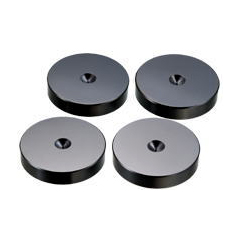
I have yet to use a better spike shoe.
There is a caveat. The silicone ring on the underside doesn't bear any load but it does make them immobile when the slighted pressure is applied. I find starting with Linn Skeet helps because they slide easily over wood floors without scratching so you can get the position just so. Then swap them out one-by-one for the Kirptons once the positioning is set. They have a range of sizes and masses going from low cost to silly money (starting at about 50 quid for 4 going to around 200 quid).
It is a fascinating write up and echoes some things I have seen in the past with some more exotic attempts. The most extreme of which was concrete blocks loaded down deep into the earth several metres surrounded by another concrete containment filled with water creating a moat. The central concrete bore rising up through a hole cut in the wood floor to be flush with the surrounding floor itself with the speakers resting on that. I cannot imagine anyone going to that extreme (even when building a new home) but someone's done it.
Back down to earth, I found a good compromise between concrete plinths (which I cannot use for a number of reasons) and smaller spike shoes are these items from Kripton:
I have yet to use a better spike shoe.
There is a caveat. The silicone ring on the underside doesn't bear any load but it does make them immobile when the slighted pressure is applied. I find starting with Linn Skeet helps because they slide easily over wood floors without scratching so you can get the position just so. Then swap them out one-by-one for the Kirptons once the positioning is set. They have a range of sizes and masses going from low cost to silly money (starting at about 50 quid for 4 going to around 200 quid).
feeling_zen,
Interesting, that the Kriptons have silicone ring on the bottom to (presumably) prevent movement, and clever that you position things first with the Lynn Skeet. The Naim Chips retail for $35, I think, and seemed expensive (to me) at first. I like them because they are solid, have a fairly large, high conical depression in the topside to keep pointed feet from jumping out when moved a small amount. Plus, there is a several mm diameter center to accept the points. This center is milled out from above and below, and forms a "diaphragm" which is a modestly stiff spring of sorts. My guess is this may be essential for speakers with four point support, to help increase the tolerance for adjustment of the four feet without inducing micro-rattle.
Charlie
Charlie,
I think this is a valuable post for those with interest in addressing the matter and you've done a nice job explaining the issue and its treatment. Having a similar room construction to yours I've gone as far as placing concrete tiles on carpet and under my speakers to positive effect. The Naim Chips make sense for me as the next logical step, though I'm not ready to spend there yet.
It was also nice to have a direct discussion of the matter with you at our meet up. One question; did you have the three bearings under each chip when I was there? I don't remember talking about them.
Charlie, interesting read.. I have found gaining optimum speaker set up an interesting yet infuriating part of the hobby.. Lots of trial and errors.. I use large standmounts, and I found with very high mass stands with a lossy coupling to speaker cabinet I found the bass was strong but a little lumpy, and the treble and upper mids smeared.. Impressively awful. At the other end I tried light open framed steel stands on Pulsar Points with concrete floor, and directly coupled with carbonfibre to the speaker. This was wonderfully articulate, tight and clear... Layers and layers.. But to my ears perhaps a little too thin in the lower mids and some prominence in the upper mids.
Eventually I used Torlyte and wood (oak) open frame stands, spiked to concrete floor, and used the Pulsar Points between speakers and stand.. It was excellent.. Clear extended and proportionate bass with no lumpiness, but as importantly, clear articulate and intricate mids and highs, that allow me to hear into the music.. Kind of like being able look at a detail of a painting masterpiece or being able to appreciate the completed picture as a whole..and with music as with art these can be symbiotic or quite seperate.
So it pays to experiment, and ultinmately I think it is about building the right sort of lossy coupling between speaker and floor...
Simon
PS my speaker ATC SCM 19 mk 2
I bought a couple of granite boards for under my Naim SL2s that just sit on normal carpet. Allowed me to get them very level and very stable. Results were much improvement all around in tighter bass, more accurate treble plus I could slide them for fine positioning adjustment which saved loads of time rather than having to take apart, move the bass cabinets, etc etc.
Overall cost around £30 from a well known online retailer.
I have a poured thick depth concrete with thick hardwood flooring glued down on it, so lucky in some respects that a good surface is provided for my system.
i use Ceraball footers on my speakers - two parts joined by a ceramic ball and damped by a rubber o ring. And use the larger Ceraball base footers under my system support. Seems trouble free to me.
in the past I have used granite slabs .these had an audible ringing that was tuned out somewhat with a sticky thick felt applied to the underside. Along with the Pulsar points worked well with speakers I used at the time. The Speaker / Floor interface shouldn't be to damped I think . As long as there is no micro chatter.
Like most of us, I've experimented with various interfaces under my speakers. When I had SL2s I tried marble slabs but it killed the PRaT. Two made it even worse. Back to Naim Chips. Then I tried large philips-headed screws, fixed into the compressed mud and flint subfloor (it's an old cottage) with the heads protruding through the oak floorboards so the speaker spikes could locate in the centre of each screw, and that was even better. A real fiddle to do though and of course you can't then reposition the speakers without a great deal of bother.
With the DBLs I have now, the screw method wasn't really on the cards (SWMBO rebelled against my drilling any more holes in the floor) so back to Chips. DB was over & suggested we try inverting the Chips and this works surprisingly well, even if a bit fiddly to ensure the spikes are dead centre in the underside of the chip. I recently tried a set of Chord Silentmounts, stainless steel machined disks, that some here have found an advantage, but they didn't work at all, killing the life of the music. I suspect they might be more effective on carpet.
Surprised at upside down Chips, Tony. But as DB says, if it works, it works.
C.
I have a poured thick depth concrete with thick hardwood flooring glued down on it, so lucky in some respects that a good surface is provided for my system.
After much experimentation this closely mirrors my current configuration, stand spikes directly onto the floor, via chips was not great. As concrete is the base material in my room and there is no other surface (apart from floor paint) I had to fashion and glue some 'flooring' rectangles for the stands to go on. I made these from some ancient stock of elm I have (an old staircase renovation leftovers). I spike directly onto the wooden surface and it made quite a difference to the times when there's a lot of hf energy in the music, presentation is a lot more relaxed, less 'shrill'.
Then I tried large philips-headed screws, fixed into the compressed mud and flint subfloor (it's an old cottage) with the heads protruding through the oak floorboards so the speaker spikes could locate in the centre of each screw, and that was even better. A real fiddle to do...
Yes! That was my final setup when I lived in a stables conversion, although the reason I did it was because there was a ridge in the carpet in one corner of the room that refused to 'go away' and the longest stand spikes were not long enough to get through the Wilton and underlay properly (hence dunken speaker stand syndrome). Worked a treat but required stencils made from cornflakes packets. Never assume two speaker stands are the same!
In an earlier age (me not the world) I found solid or high density stands to be extremely problematic unless the speakers were design with that addition mass support in mind. ridgid stability seemed to outperform high mass. I think the dame is true for floorstanders and only experimentation will reveal whether a high mass slab works as a stable plinth seperate to the speaker or acts to increas the mass of the speaker itself which significantly changes the character of the sound.
Add carpet and an unwillingness to use spikes and it just gets 10 times harder.
I also use rigid high mass plinths under my speaker stands, but in my case they are a little different - they are laminated.
Bottom layer is a 450mm x 450mm x 8mm ceramic floor tile these are inherently very rigid, but resonant as a result of that.
Middle layer is 4 'bricks' from inside a night storage heater 210mm x 190mm x 40mm - these were selected for their inherently 'dead' sonic signature and very high density (ρ = 4000).
Top layer is another 450mm x 450mm x 8mm ceramic floor tile.
The layers are bonded together using a modified silane structural adhesive that ensures that the layers are close coupled and that there are no acute resonance peaks in the audio band.
Each plinth weighs 35kg.
The hard glazed surface of the tiles, which very flat and has a very smooth micro-texture, provides an ideal surface to slide over most flooring surfaces without causing damage, and also provides a good surface for the spikes to rest on.
These plinths stand on a thin carpet covering a suspended softwood floor. The improvements in sound on adding these plinths are a considerable increase in audible detail and a tighter mid bass response. It's particularly noticeable that the presence of strong bass in the signal has much less 'muddying' effect on the midrange detail. Touching the bass of the speaker stand, it's noticable that there is much less vibration now than before the plinths were put in place
... One question; did you have the three bearings under each chip when I was there? I don't remember talking about them.
joerand, the balls were a more recent addition.
im going to have to try this out tonight, as I have a suspended floor and naturally assumed that some concrete plinths would help to give tighter bass and more focus.
I will remove them later and see if this has an effect.
I appreciate hearing about what people are doing, and what they have tried that works or doesn't work, and how they sound. For me at least, this remains an emperical approach - one of trial and error, guided by only tentative intuition.
My speakers are obviously floor standers, and I really have no experience with using stands - which seem to pose new challenges.
Many years ago, with different speakers and (non Naim) equipment, I was using bicycle inner tubes to soft-isolate or float the speaker bases. It was an improvement to place the speakers points on concrete slab with inner tubes undertake slabs. Eventually I abandoned the inner tubes. My system was so different then, and much less articulate, so I can draw few conclusions from those days.
The sun is not yet up here, and I am off to make my first cup of coffee.
Cheers,
Charlie
Naim speakers are for me an example of thoughtful design of the speaker-floor interface. Their floorstanders have a base or plinth which sits on points or points plus Chips. The speaker cabinet then sits on the plinth with two hard points at front and a linear metal spring at the rear. The spring provides a subsonic rocking mode, which is a mechanical lowpass filter that decouples rocking forces at audio frequencies. Considerable attention is paid to making things linear.
From the perspective of being a loudspeaker designer (however amatuer) I have always been uncomfortable with the notion of stand mounted speakers. Given the importance of the effect a stand will have on the final sound, it seems irresponsible to leave this to chance. Fortunately, many mmanufacturers offer a stand which is hopefully designed to work as a system with their speaker. Naim have done this with the nSat. I note with the nSat there is a hard three-point interface between stand and speaker, which also works with their wall mount brackets.
It is a fascinating write up and echoes some things I have seen in the past with some more exotic attempts. The most extreme of which was concrete blocks loaded down deep into the earth several metres surrounded by another concrete containment filled with water creating a moat. The central concrete bore rising up through a hole cut in the wood floor to be flush with the surrounding floor itself with the speakers resting on that. I cannot imagine anyone going to that extreme (even when building a new home) but someone's done it.
Back down to earth, I found a good compromise between concrete plinths (which I cannot use for a number of reasons) and smaller spike shoes are these items from Kripton:
I have yet to use a better spike shoe.
There is a caveat. The silicone ring on the underside doesn't bear any load but it does make them immobile when the slighted pressure is applied. I find starting with Linn Skeet helps because they slide easily over wood floors without scratching so you can get the position just so. Then swap them out one-by-one for the Kirptons once the positioning is set. They have a range of sizes and masses going from low cost to silly money (starting at about 50 quid for 4 going to around 200 quid).
feeling_zen, have you compared the Kriptons to Naim Chips?
Like most of us, I've experimented with various interfaces under my speakers. When I had SL2s I tried marble slabs but it killed the PRaT. Two made it even worse. Back to Naim Chips. Then I tried large philips-headed screws, fixed into the compressed mud and flint subfloor (it's an old cottage) with the heads protruding through the oak floorboards so the speaker spikes could locate in the centre of each screw, and that was even better. A real fiddle to do though and of course you can't then reposition the speakers without a great deal of bother.
With the DBLs I have now, the screw method wasn't really on the cards (SWMBO rebelled against my drilling any more holes in the floor) so back to Chips. DB was over & suggested we try inverting the Chips and this works surprisingly well, even if a bit fiddly to ensure the spikes are dead centre in the underside of the chip. I recently tried a set of Chord Silentmounts, stainless steel machined disks, that some here have found an advantage, but they didn't work at all, killing the life of the music. I suspect they might be more effective on carpet.
Charlie, interesting read.. I have found gaining optimum speaker set up an interesting yet infuriating part of the hobby.. Lots of trial and errors.. I use large standmounts, and I found with very high mass stands with a lossy coupling to speaker cabinet I found the bass was strong but a little lumpy, and the treble and upper mids smeared.. Impressively awful. At the other end I tried light open framed steel stands on Pulsar Points with concrete floor, and directly coupled with carbonfibre to the speaker. This was wonderfully articulate, tight and clear... Layers and layers.. But to my ears perhaps a little too thin in the lower mids and some prominence in the upper mids.
Eventually I used Torlyte and wood (oak) open frame stands, spiked to concrete floor, and used the Pulsar Points between speakers and stand.. It was excellent.. Clear extended and proportionate bass with no lumpiness, but as importantly, clear articulate and intricate mids and highs, that allow me to hear into the music.. Kind of like being able look at a detail of a painting masterpiece or being able to appreciate the completed picture as a whole..and with music as with art these can be symbiotic or quite seperate.
So it pays to experiment, and ultinmately I think it is about building the right sort of lossy coupling between speaker and floor...
Simon
PS my speaker ATC SCM 19 mk 2
Simon, it appears you have your system dialed in. Your description of the sound is consistent with what I am hearing. My attempts at using soft coupling such as sorbothane or rubber were a disaster sonically. My mental model for that is that the hysteresis in the isolators made the vibration nonlinear, resulting in modulation noise in the music. It could also be that the soft coupling resulted in higher levels of caninet vibration.
Your current configuration uses points (three or four?) at both interfaces (stand-to-floor and stand-to-speaker). The previous configuration used a different stand as well as a different stand-to-speaker interface. Do you have a feel for what accounted for the midrange improvement? Was it the stand, interface or both? Do you thimk the difference was because of a chang in cabinet vibration levels? Or was the vibration just more linear?
Charlie
GraemeH, thanks for the link. Interesting that PMC says one must spend a lot of money to make things work. 