I started this thread because I received a phone message from a forum member asking about the bases under my speakers. Unfortunately, I could not quite make out the correct phone number nor do I know his forum name. Hopefully this may address his questions. Having said that, it would be fine if a discussion ensues.
Here is my current configuration, which is providing me the best music replay I have yet enjoyed. This is not to say that it could not be improved!

There is wool carpet on the oak hardwood, under which is a suspended wood-framed floor, under which is a crawl-space. 16" square by 2" thick concrete slabs (gray) sit on the carpet. The speakers have three pointed cone feet, which I think are brass. The cones sit in Fraim Chips. Under each frame chip are three 3/16" diameter ball bearings. Because of the textured upper surface of the concrete, the balls do not roll.
Until last spring, these speakers sat for many years with their spikes through the carpet into the hardwood, which left small dimples. My system was in storage through summer, and the hardwood floors were refinished. For two months the carpet remained in storage and the speakers sat on the new Fraim Chips, as a necessity to avoid dimples in the newly-finished oak flooring. I cannot comment on the sonic difference contributed by the Chips, compared to no Chips, because several months ensued and my shelving was rebuilt with closer attention to cable dressing. When the carpet was finally returned, two months ago, I faced the challenge of whether to trim the carpet shorter, or do something else? Really, just as an experiment, I procured these concrete slabs. Similar arrangements have been reported as effective by several forum members.
Initially I placed the speaker's cones directly onto the concrete upper surface. Letting this configuration "settle in" a few days, I felt with considerable relief that it sounded better than when the chips sat directly on the oak flooring absent the carpet. The points tended to "dig in" a bit to the concrete, making a bit of grit. (Each speaker weighs about 100 lb). This made me a bit concerned (for the sound, not the concrete), and I had these Chips sitting there, so I tried putting the chips under the points. Again listening for a few days I felt the Chips a worthwhile addition, confirmed when removed. The effect of the Chips was not profound, but the improvement was there. A similar concern led me to try the balls under the chips - in an attempt to further linearize the interface. Again, I felt there was an improvement, if perhaps subtle. I have not yet tried to remove the little ball bearings - they are "swearing nuisance" to fit, with my wife's patient assistance.
My motivation is to have the best possible natural sound. In service of this, I try to minimize within reason the vibration of the speaker itself and the floor. Further, it is essential that what vibration remains (there will always be some, however small) must be highly linear - free of micro-rattle and hysteresis.
I have to say that my music has never sounded so wonderful - due principally to other improvements I have made - which makes me disinclined to experiment further. But I am open to persuasion if there is a better way.
Charlie
Posted on: 16 November 2015 by Simon-in-Suffolk
Charlie, I agree with standmounts, you must match your stand perfectly for successful operation.. and even then not all speaker manufacturers' recommendations work best in all rooms. However the flip side is that standmounts can nearly always be made to work exceedingly well for a given room, in a way that is not always possible with floor mounts.. At least in my experience.
I also agree that three way supports are essential for robust coupling and stability, and that is what I employ on my largish standmounts and on their stands.
SimonhoHowever
Posted on: 16 November 2015 by Steve2
CharlieP!
I phoned you on Sunday requesting further information on your set up. Thank you very much indeed for taking the time and trouble to respond. By doing so publicly there is even more information to digest! I am very close to finishing my loudspeakers and have just been informed today as it happens that the two pieces of black 30mm thick Granite that I ordered for the plinths are ready for collecting.......
I have veneered the sides and front of the speakers with maple veneer which is quite light and wanted the aesthetic appearance of the Black Granite to compliment the black leather of the top half of the front baffle.
However, I did not want to do that at the expense of the sound which is why I wanted to pick your brains so to speak. I have Engineered Oak floorboards on compressed Paper (Foxtrot underlay) on top of a concrete base. I was thinking of using some form of Mastic to join the speakers to the Granite but am still dithering about with what to do.
Lovely system by the way and thanks everyone for your contributions to the discussion.
SteveT
Posted on: 16 November 2015 by CharlieP
I have often wondered if/when there could be issues with various floor protectors:
- They add an additional mechanical interface (between bottom of protector and floor)
- What accounts for differences in performance, if any, between different brands/models?
The differences that I can think of are: 1) material, 2) stiffness, 3) coupling to point on top, 4) coupling to floor on bottom. In my ignorance, I am tempted to think 1 and 2 are the same.
Like many others, I am forced to use them to protect our new floors (I wish to remain happily married). Does anyone use these strictly for sound quality purposes?
Coupling to point above: I note that the Naim Chips have a several mm wide flat surface on which to place a point from above. Accepted wisdom is that the point should be centered. I tentatively agree with the centering, but have tested it only casually. I suspect the small flat interface could reduce coupling with point from above, as compared to other designs which have a conical dimple. Some forum members have reported sound quality degradation when point from above touches the edge of the circular flat area. This could be a micro-rattle issue? Or is it increased lateral coupling? Or ???
Coupling to floor below: Different designs have different diameters, and may or may not be flat. I was concerned about the interface from the Chips to the pebble-textured upper surface of my concrete slab, which inspired me to place ball bearings between them. DB has reported improvements resulting from using Naim Chips upside down - which presents a smaller diameter, concentric surface to the floor.
Does vertical stiffness of the floor protector matter? I'm sure it can, but if so it would surely be system-dependent. If four points are used on a speaker, then having a bit of vertical compliance would minimize likelihood of rattles.
DB,
It was your post about using the Chips upside down that got me to thinking about the lower surface interface and inspired me to try the ball bearings. Thank you! Like so many forum members, I benefit from your many informative posts. What was the floor surface when you inverted the Chips?
Red Rooster,
Interesting that you preferred Naim Chips to Silent Mounts. What was your floor surface? Could there have been any micro-rattle using these at four points? Micro-rattle certainly kills PRaT.
The scientist in me hopes to rationalize the different things we report hearing, but I suspect this may be futile. There are so many variables, and peoples sonic preferences differ.
Charlie
Posted on: 16 November 2015 by CharlieP
Originally Posted by Huge:
I also use rigid high mass plinths under my speaker stands, but in my case they are a little different - they are laminated.
Bottom layer is a 450mm x 450mm x 8mm ceramic floor tile these are inherently very rigid, but resonant as a result of that.
Middle layer is 4 'bricks' from inside a night storage heater 210mm x 190mm x 40mm - these were selected for their inherently 'dead' sonic signature and very high density (ρ = 4000).
Top layer is another 450mm x 450mm x 8mm ceramic floor tile.
The layers are bonded together using a modified silane structural adhesive that ensures that the layers are close coupled and that there are no acute resonance peaks in the audio band.
Each plinth weighs 35kg.
The hard glazed surface of the tiles, which very flat and has a very smooth micro-texture, provides an ideal surface to slide over most flooring surfaces without causing damage, and also provides a good surface for the spikes to rest on.
These plinths stand on a thin carpet covering a suspended softwood floor. The improvements in sound on adding these plinths are a considerable increase in audible detail and a tighter mid bass response. It's particularly noticeable that the presence of strong bass in the signal has much less 'muddying' effect on the midrange detail. Touching the bass of the speaker stand, it's noticable that there is much less vibration now than before the plinths were put in place
Huge,
Your application is somewhat similar to mine. Your slabs are slightly larger, and thicker and perhaps twice the mass of what I am using. I know from other posts that you have devoted considerable effort to this as well as room treatment and correction, presumably to good effect.
My accelerometer still sits in the box awaiting some "spare time" on my part. However I have noted subjective vibration levels: when I touch the floor I feel vibration, and when I listen with my ear against the floor I can hear even some midrange. On the slab, vibration is below perception. I am pretty sure the floor is excited acoustically, not mechanically.
I was initially concerned that the carpet might introduce hysteresis, but I do not hear any such effects n music replay. I suspect this is because the vibration of the slab is so minimal as to not play a roll.
Do you use the same slab and points under your subwoofer?
Charlie
Posted on: 16 November 2015 by feeling_zen
Originally Posted by CharlieP:
Originally Posted by feeling_zen:
It is a fascinating write up and echoes some things I have seen in the past with some more exotic attempts. The most extreme of which was concrete blocks loaded down deep into the earth several metres surrounded by another concrete containment filled with water creating a moat. The central concrete bore rising up through a hole cut in the wood floor to be flush with the surrounding floor itself with the speakers resting on that. I cannot imagine anyone going to that extreme (even when building a new home) but someone's done it.
Back down to earth, I found a good compromise between concrete plinths (which I cannot use for a number of reasons) and smaller spike shoes are these items from Kripton:
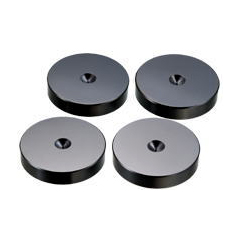
I have yet to use a better spike shoe.
There is a caveat. The silicone ring on the underside doesn't bear any load but it does make them immobile when the slighted pressure is applied. I find starting with Linn Skeet helps because they slide easily over wood floors without scratching so you can get the position just so. Then swap them out one-by-one for the Kirptons once the positioning is set. They have a range of sizes and masses going from low cost to silly money (starting at about 50 quid for 4 going to around 200 quid).
feeling_zen, have you compared the Kriptons to Naim Chips?
No. I never made as far as Chips.
For me, the thin silicone ring inset on the underside of the Kriptons was a major point because it makes them truly laterally immobile with even the slightest pressure (you can find a thread from when I used Skeet and my wife pushed the speakers with the hoover). The load is borne entirely by the high carbon steel of the pucks and the silicon provides just enough contact grip to hold them in place.
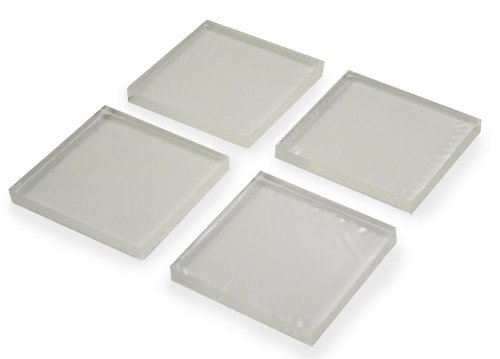
The PMC FAQ with the mention of bluetak got me thinking. For those of you with stand mounts and/or granite slabs, silicone earthquake pads might be worth a try. They cost next to nothing, I guess between $5 and $10 for a pack, come in many pre-cut sizes and even the small ones can take a load of around 100Kgs. Either between speaker and stands or granite slab and wooden floor. You can have them down for years and they never pull the varnish up when removed. The PMC article mentions spikes or bluetak as being ideal which is a little strange as they do different things. Spikes dampen by decoupling contact area and bluetak by absorbance. If going the absorbance route, these pads might be the ticket, especially sandwiched between floor and granite or pairs of granite slabs. They are specifically designed to provide enough compression and stretch to hold heavy items in a magnitude 7 quake by letting the supporting load move about.